

Quice Summary
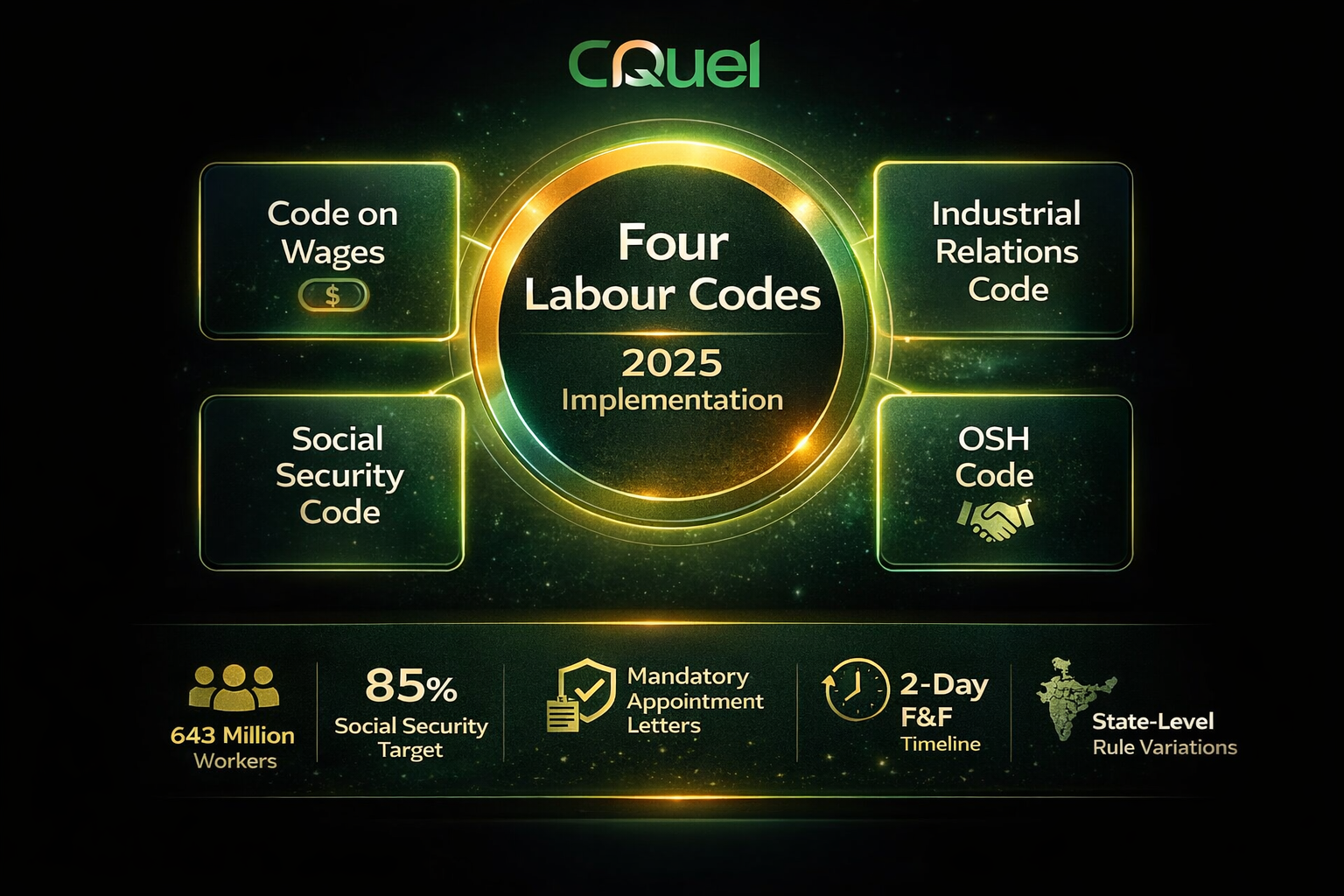
- India implemented the four new labour codes nationwide on November 21, 2025, replacing 29 outdated labour laws
- The reforms impact 643 million workers across India
- Social security coverage has already expanded from 19% in 2015 to 64% in 2025, with a projected rise to 85% under the new codes
- Layoff approval thresholds increased to 300 workers in many cases
- Fixed-term employees are now eligible for gratuity after one year
- Mandatory appointment letters are required for all workers
- Wages must be paid by the 7th of the following month
- Annual health check-ups are mandatory for employees above 40 under the OSH Code
If you manage HR, payroll, compliance, or run a business in India, these reforms directly affect how you structure salaries, handle statutory deductions, and prepare for inspections.
If the new labour codes are meant to simplify compliance, why does implementation suddenly feel more complex?
Across India, startups, SMEs, IT companies, manufacturers, and large enterprises are facing the same reality:
- Salary structures may need restructuring
- PF and gratuity calculations may increase
- Appointment letters require revision
- State-wise notifications differ
- Inspection readiness standards are changing
- Final settlement timelines are tightening
The reform is historic, but the transition requires clarity.
On November 21, 2025, India officially replaced 29 labour laws with four consolidated codes.
Prime Minister Narendra Modi described them as: “One of the most comprehensive labour-oriented reforms since Independence… empowers workers while simplifying compliance.” – PM Narendra Modi, November 2025
At the same time, trade unions raised concerns, and several states began drafting separate implementation rules.
This creates a practical business reality:
The reform is national. The implementation is state-specific. The compliance responsibility is yours.
Why This Reform Is Structurally Different From Past Labour Changes
Unlike incremental amendments, these codes change foundational definitions.
They:
- Introduce a new wage definition affecting PF & gratuity
- Expand social security to gig and platform workers
- Raise layoff and standing order thresholds
- Mandate universal appointment letters
- Enable digital inspections
- Tighten timelines for 2-day full & final settlement
- Permit women to work night shifts with safeguards
They also aim to boost formalisation.
Workforce formalisation is projected to rise from 60.4% to 75.5%. A reduction of up to 1.3% in unemployment (resulting in77 lakh additional jobs) is projected post-implementation.
This is not a cosmetic reform.
It is structural.
Before we go deeper into each code, here’s a detailed video breakdown that explains how the four new labour codes work, what changed from the old 29 laws, and what businesses must prepare for in 2026.
Who Is Directly Affected?
The short answer: almost everyone.
The long answer:
Employers
- Need to reassess wage structure compliance
- Must update HR documentation
- Face higher penalties for non-compliance
- Must prepare for digital inspection models
HR Teams
- Must revise appointment letters
- Ensure wage definition alignment
- Update compliance training
- Manage OSH requirements, including health check-ups
Payroll Teams
- Recalculate PF contributions
- Audit gratuity exposure
- Align salary breakups with 50% wage rule
- Prepare for statutory deduction audits
Startups & IT Companies
Many assumed labour codes applied mainly to manufacturing.
However:
- OSH Code applies broadly
- Health check-ups may apply depending on the workforce size
- Standing order thresholds changed
- Fixed-term employment now has gratuity eligibility
If you run payroll in India, the labour codes affect you.
Why 2026 Is the Critical Compliance Year
Although the codes became effective in late 2025, many states are still finalising rules.
This means:
- Old rules may apply temporarily
- State notifications must be tracked
- Transitional compliance risks exist
- Businesses must stay audit-ready
As Lokesh Gulati, Partner at PwC India, stated: “Modernise India’s labour framework… simplify compliance while reducing friction.”
But simplification only works if businesses adapt correctly.
What This Guide Will Help You Do
This 2026 compliance guide will help you:
- Understand the four labour codes clearly
- Decode the new wage definition
- Learn how labour codes affect payroll restructuring
- Understand PF & gratuity changes
- Clarify ESIC applicability under the new codes
- Prepare for OSH Code obligations
- Build an audit-ready labour compliance checklist
- Understand penalties and inspection preparedness
- Navigate state-wise compliance challenges
This guide is informational, neutral, and compliance-focused.
Because under the new labour codes, compliance is no longer optional; it is a mandatory requirement. It is an operational discipline.
What Are the Four Labour Codes?
India’s labour law framework was historically built through 29 separate Acts passed over decades.
This created:
- Overlapping compliance requirements
- Conflicting definitions (especially wages)
- State-level interpretation differences
- Documentation complexity
- Increased inspection ambiguity
To simplify and modernise the system, the Government consolidated these 29 laws into four labour codes, implemented nationally in November 2025.
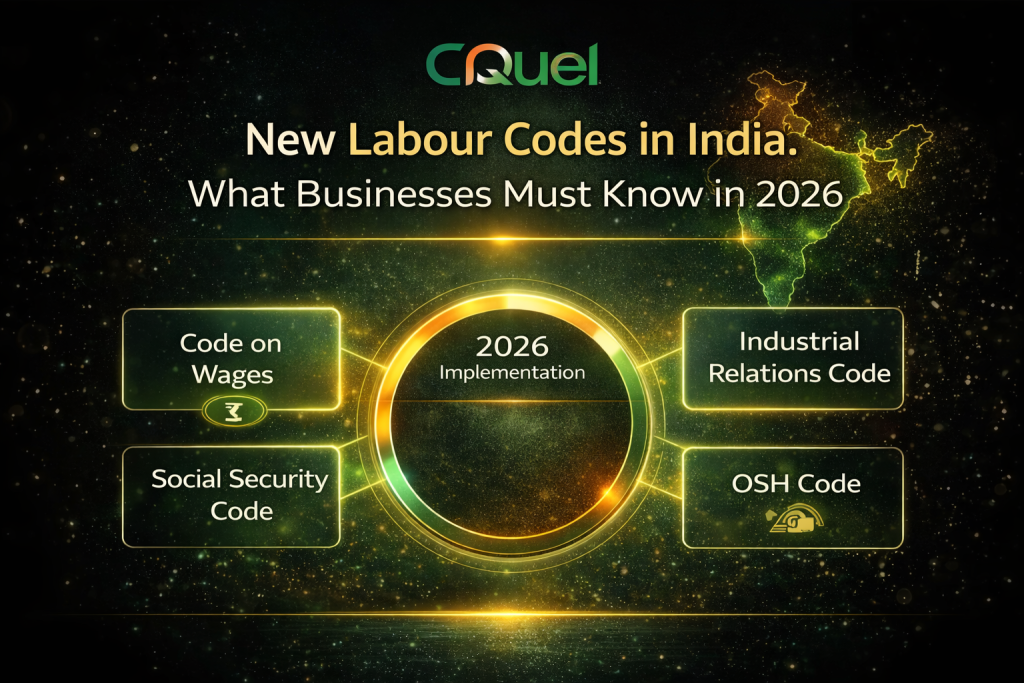
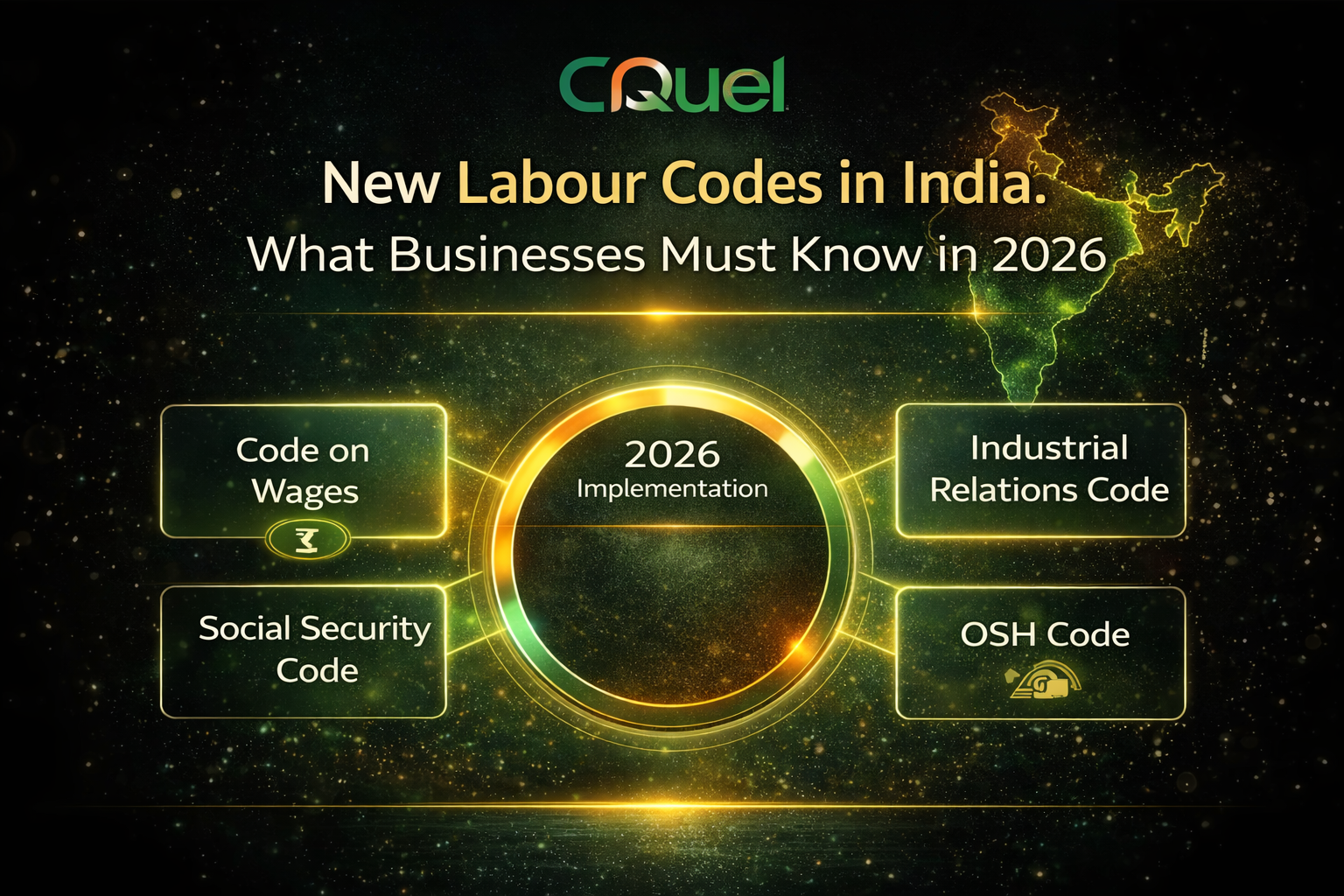
Together, these four codes govern:
- Wages
- Industrial relations
- Social security
- Occupational safety & working conditions
Let’s break them down clearly.
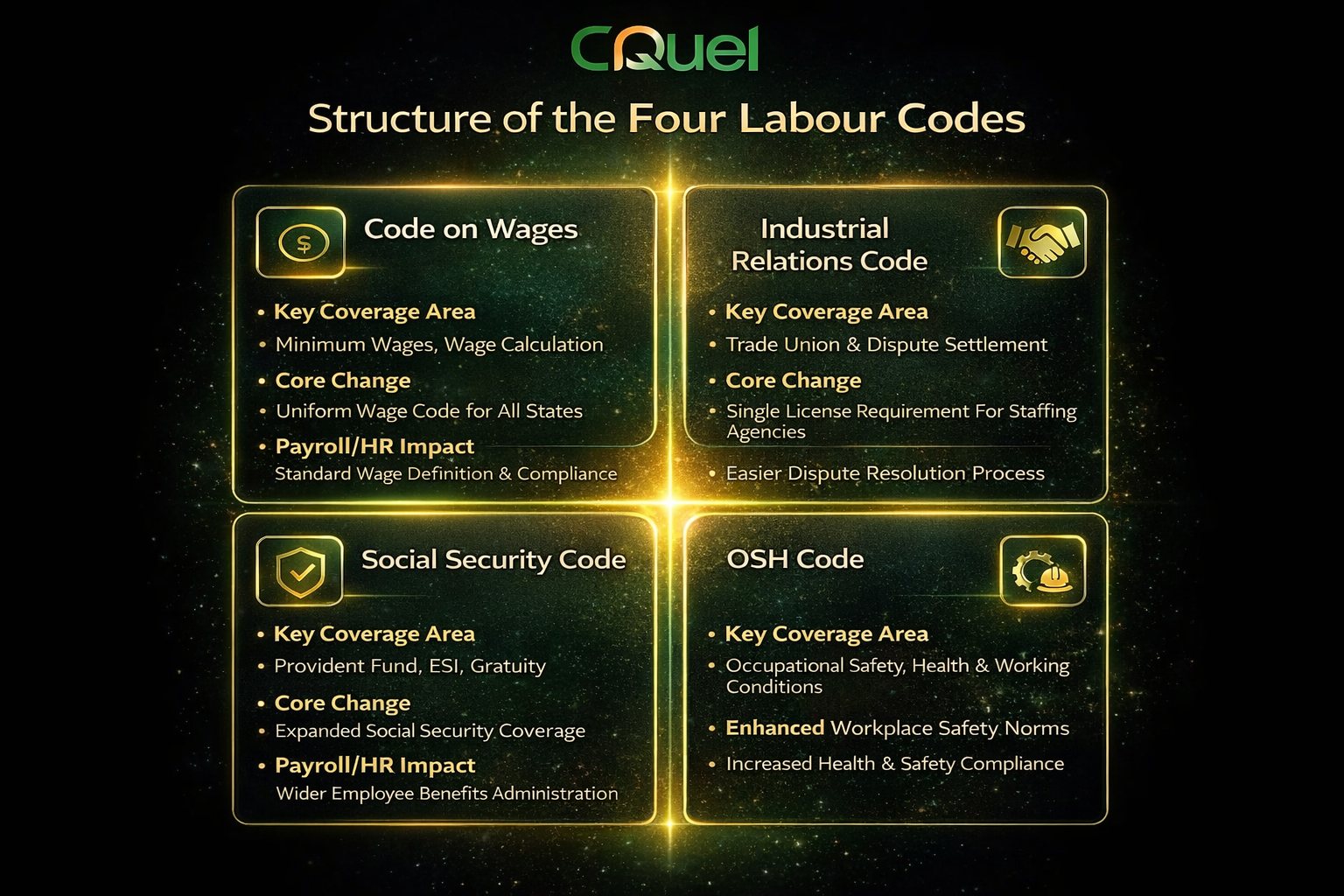
Code on Wages, 2019
The Code on Wages applies to all employees across organised and unorganised sectors.
It replaces:
- Payment of Wages Act
- Minimum Wages Act
- Equal Remuneration Act
- Payment of Bonus Act
Universal Minimum Wages
For the first time, minimum wages apply universally, not limited to scheduled employment.
This means:
- Every employee is covered
- No sectoral exclusion
- Uniform compliance obligation
National Floor Wage – India
The Central Government now sets a National Floor Wage.
States:
- Cannot fix minimum wages below this floor
- Must align state-level wages accordingly
This creates a baseline across India, while allowing regional flexibility.
New Wage Definition
This is the most impactful change for payroll.
The Code introduces a standardised definition of “wages,” which includes:
- Basic pay
- Dearness allowance
- Retaining allowance
It excludes certain allowances, but with a condition:
If exclusions exceed 50% of total remuneration, the excess must be added back into wages. This is commonly referred to as the “50% basic rule,” though technically it is a wage component balancing rule.
Impact areas:
- PF calculation
- Gratuity liability
- Bonus computation
- Leave encashment
We’ll decode this in detail in the payroll section.
Industrial Relations Code, 2020
This code governs employer–employee relations, layoffs, retrenchment, and standing orders.
It replaces:
- Trade Unions Act
- Industrial Employment (Standing Orders) Act
- Industrial Disputes Act
Standing Orders Threshold
Standing orders are now required for establishments employing 300 or more workers (the earlier threshold was 100 in many states).
This provides:
- Operational flexibility for mid-sized businesses
- Reduced compliance load for smaller units
2-Day Full & Final (F&F) Settlement
The Code mandates that full and final settlement must be completed within 2 working days in case of resignation or termination.
This significantly impacts:
- Payroll exit processing
- HR documentation timelines
- Final dues calculation
- Leave encashment accuracy
Delays may attract penalties.
Social Security Code, 2020
This code consolidates laws related to:
- Employees’ Provident Fund (EPF)
- Employees’ State Insurance (ESIC)
- Gratuity
- Maternity benefits
- Gig & platform workers
PF & Gratuity Changes
Because of the new wage definition:
- PF contribution base may increase
- Gratuity liability may increase
- Fixed-term employees become eligible for gratuity after 1 year
This increases long-term employee benefit exposure for employers.
ESIC Applicability – PAN India
The Social Security Code allows for PAN-India ESIC expansion, subject to notification.
This means:
- Wider coverage
- Reduced ambiguity across states
- Greater compliance monitoring
Gig Worker Inclusion
For the first time:
Gig and platform workers are formally recognised under social security provisions. This is a structural shift in India’s labour protection framework.
Occupational Safety, Health and Working Conditions (OSH) Code, 2020
The OSH Code merges 13 labour laws related to working conditions.
It applies broadly to:
- Factories
- Mines
- Plantations
- Establishments meeting threshold requirements
- IT/ITeS companies (depending on workforce size and notification)
Mandatory Health Check-Ups
Under the OSH Code:
- Employees above 40 years may require annual health check-ups
- Employer cost responsibility applies
This adds a new compliance obligation for HR teams.
IT / ITeS Applicability
Many IT companies assumed OSH provisions applied only to manufacturing.
However:
- Working condition standards
- Safety norms
- Appointment letter mandates
- Working hour regulations
May apply depending on establishment size and state rules.
Mandatory Appointment Letters
All employers must issue written appointment letters to employees.
This standardises employment documentation across India.
Why These Four Codes Matter Together
Individually, each code addresses a different area.
Together, they:
- Standardise wage definition
- Formalize workforce protections
- Expand social security
- Digitise inspection processes
- Reduce overlapping legislation
But they also increase:
- Documentation expectations
- Payroll accuracy requirements
- State-rule monitoring responsibility
The reform simplifies the law structure.
It does not reduce compliance accountability.
State-Wise Implementation & Compliance Challenges
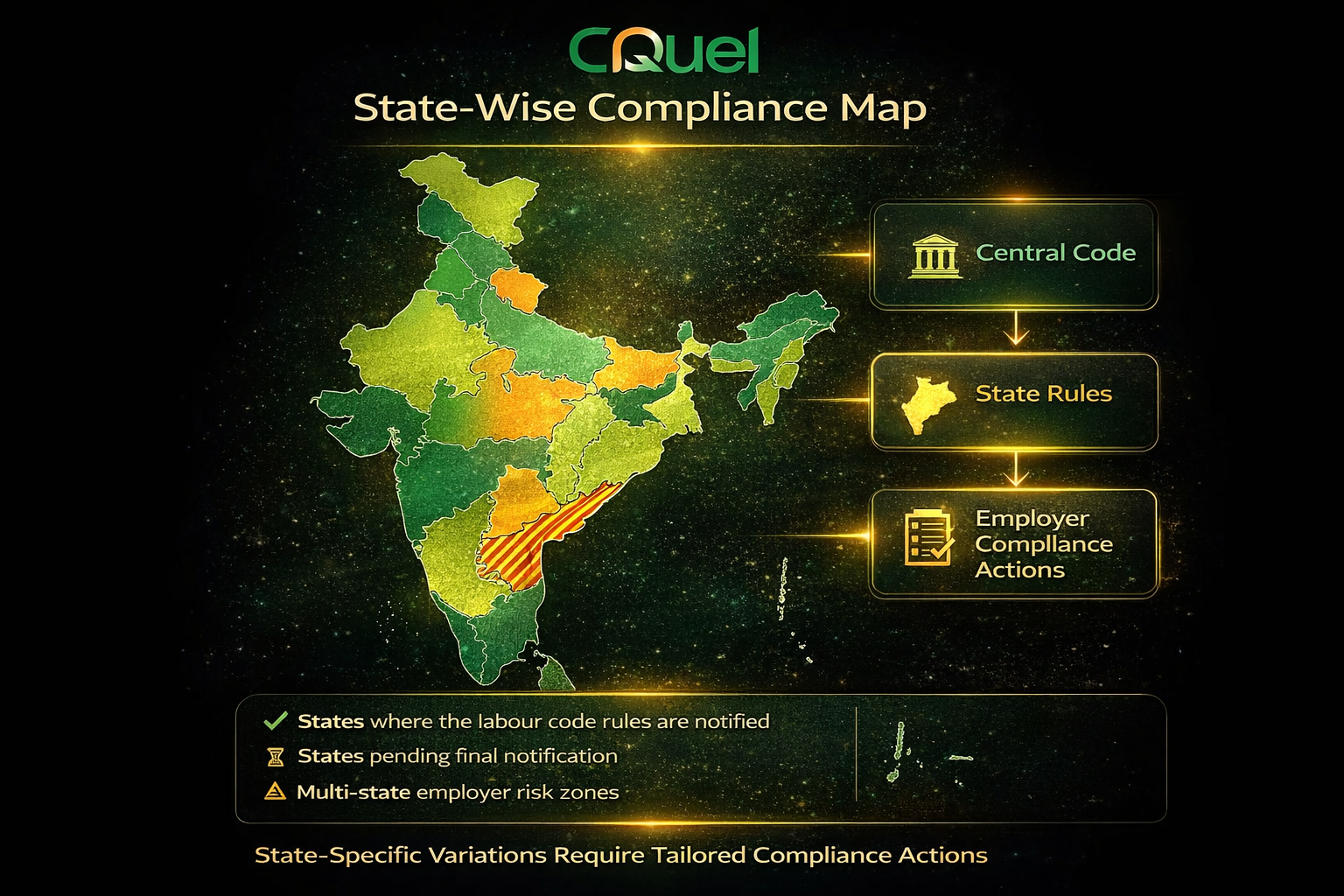
If you’re waiting for a single nationwide “go-live” announcement, that’s not how this will unfold.
The four labour codes are Central laws. But the actual rules that affect your daily compliance inspections, forms, registers, health check-ups, and ESIC enforcement are notified state-wise.
That means your compliance status depends on where you operate.
And if you operate in more than one state?
Your risk multiplies.
Why State Implementation Creates Real Confusion
Here’s where most companies underestimate the complexity.
You might have:
- A head office in Karnataka
- A warehouse in Maharashtra
- A sales office in Delhi
- Remote employees across multiple states
Each state must notify its own rules under:
- Code on Wages
- Industrial Relations Code
- Social Security Code
- OSH Code
Until a state finalises its rules, certain operational details remain transitional.
That’s why two companies in different states may face different inspection formats, timelines, and documentation expectations even under the same central code.
This is not theoretical.
It directly affects:
- Your health check-up compliance
- Your appointment letter format
- Your inspection documentation
- Your grievance and standing order obligations
- Your digital record-keeping readiness
Jurisdiction-Specific Compliance: What It Means for You
Jurisdiction-specific compliance simply means:
Your compliance process must align with the state where the employee works, not just where your company is registered.
If you have remote workers in another state:
You may be subject to that state’s OSH rules.
If you run IT or ITeS operations:
You still fall under OSH Code applicability even if traditional “factory” rules don’t apply.
If you assume the code is “only for manufacturing,” you are already misreading it.
OSH Code & State Rules: The Practical Impact
The Occupational Safety, Health and Working Conditions Code brings:
- Mandatory appointment letters
- Annual health check-ups (where applicable)
- Safety standards for certain establishments
- Registration requirements
- Digitized inspections
But implementation details, especially around frequency, documentation, and enforcement, may vary by state notification.
This is where compliance becomes operational, not legal.
Because when inspection happens, officers check:
- Updated employee registers
- Appointment letters
- Safety policies
- Health check documentation
- Statutory deduction proofs
If your documents are scattered or outdated, you are exposed even if you “intended” to comply.
Inspection Preparedness: The Real Risk Area
Under the new framework, inspections are increasingly:
- Risk-based
- Digitally triggered
- Data-driven
That means:
If your PF filings mismatch the wage structure
If your ESIC registration is inconsistent
If your appointment letters don’t reflect wage definition updates
You may be flagged automatically.
The biggest compliance mistake companies make is this:
They prepare for audits after receiving notice.
In 2026, you need to be audit-ready before notice.
What Smart Companies Are Doing Now
Instead of waiting for clarity from every state, prepared organisations are:
- Reviewing compliance across all operating states
- Standardising appointment letter formats
- Aligning payroll logic with the new wage definition
- Updating OSH documentation proactively
- Maintaining centralised digital compliance records
- Conducting internal labour compliance audits quarterly
They are not reacting.
They are restructuring governance.
Because under the new labour codes, compliance is no longer just HR’s responsibility.
It’s:
HR + Payroll + Legal + Operations + Leadership.
The Bottom Line
Central laws define the framework.
States define execution.
If your compliance strategy assumes uniformity across India, you are exposed.
If your organisation operates in multiple states, your compliance strategy must be multi-layered.
And if you want to avoid penalties, inspection disruption, or payroll corrections later state-wise readiness cannot be optional.
Labour Codes Compliance Checklist for 2026 (Audit-Ready Guide)
If you are preparing for the new labour codes implementation, this is the section you should bookmark.
Many businesses assume compliance will “settle down” once rules are notified. In reality, labour compliance in India is becoming more structured, digital, and inspection-ready.
The safest approach in 2026 is not reactive compliance; it is audit-ready compliance.
Below is a practical, HR-friendly, and payroll-ready labour codes compliance checklist designed for startups, SMEs, IT companies, and large enterprises.
Audit-Ready Labour Compliance Checklist (2026)
-
Review Salary Structure Under the New Wage Definition
Under the Code on Wages, the new wage definition (50% rule) affects:
- PF calculation
- Gratuity calculation
- Bonus eligibility
- Statutory deductions under the new labour codes
You should:
- Recalculate Basic Pay vs Allowances
- Check if Basic is at least 50% of total remuneration
- Audit payroll restructuring under labour codes
- Review CTC impact and take-home salary changes
This is critical for HR payroll compliance and future inspections.
-
Conduct a PF & Gratuity Recalculation Audit
The PF & gratuity changes under the labour codes may increase employer contribution liability.
Your compliance checklist must include:
- PF recalculation based on revised wage definition
- Gratuity impact analysis
- Review of employee benefits impact under labour codes
- Update payroll software configuration
This forms part of your internal labour compliance audit checklist.
-
Validate PAN-India ESIC Applicability
The Social Security Code expands ESIC applicability under labour codes, including potential wider coverage.
You must:
- Confirm ESIC registration status
- Verify employee threshold applicability
- Review coverage across branches and states
- Document ESIC compliance for multi-state operations
This is especially important for businesses with operations in multiple jurisdictions.
-
Update Appointment Letters (Mandatory Under OSH Code)
The OSH Code mandates appointment letters in a prescribed format.
Your HR payroll compliance checklist should include:
- Issuing appointment letters to all employees
- Updating templates to include required terms
- Ensuring clarity on wages, working hours, and benefits
- Maintaining digital records
Many inspection failures occur due to outdated appointment documentation.
-
Implement Annual Health Check-Up Policy (Where Applicable)
Under the OSH Code, certain establishments must provide:
- Mandatory annual health check-ups
- Free medical examination depending on industry and risk
This applies especially to:
- Manufacturing
- Hazardous industries
- Certain commercial establishments
Include documentation of compliance as part of your state-wise OSH code compliance preparation.
-
Prepare for 2-Day Full & Final Settlement (F&F Rule)
The Industrial Relations Code introduces stricter timelines around final settlement rules under labour codes.
Your checklist must verify:
- F&F settlement within the prescribed timeline
- Payroll system readiness for 2-day F&F settlement
- Exit clearance workflow documentation
- Settlement register maintenance
Delays can trigger penalties and inspection scrutiny.
-
Maintain Digital Records for Labour Inspection Readiness
Labour compliance in India is moving toward:
- Web-based inspections
- Risk-based digital scrutiny
- Centralized reporting
Your labour inspection checklist India file should contain:
- Wage registers
- Attendance records
- ESIC & PF challans
- Bonus and gratuity records
- Health check-up records
- Appointment letters
- Contractor compliance documents
Always keep digital and physical copies ready.
-
Conduct Labour Code Compliance Training for HR & Payroll Teams
Compliance risk often comes from internal misinterpretation.
You should:
- Conduct labour code compliance training for HR
- Train payroll teams on wage definition changes
- Educate managers on OSH Code applicability
- Update SOPs for statutory deductions
Well-trained HR teams reduce audit risk significantly.
-
Review State-Wise Labour Rules & Jurisdiction-Specific Compliance
Remember:
The central codes are enacted. But rules are notified state-wise.
Your compliance roadmap should include:
- Monitoring state-wise labour rules notifications
- Tracking state-wise OSH code compliance requirements
- Aligning jurisdiction-specific compliance practices
- Consulting local labour authorities where necessary
This is where many multi-location companies face risk.
-
Create a Labour Code Implementation Roadmap
Do not treat compliance as a one-time activity. Create a structured labour code implementation roadmap that includes:
- Phase 1: Salary restructuring
- Phase 2: Policy updates
- Phase 3: Documentation alignment
- Phase 4: Training & communication
- Phase 5: Internal audit review
This ensures sustainable compliance, not last-minute corrections.
Why This Checklist Matters
The new labour codes are not just legal reform.
They directly affect:
- Payroll impact
- Employee benefits
- Statutory deductions
- Inspection preparedness
- Financial liability
Businesses that prepare early avoid:
- Labour code penalties and fines
- Payroll disputes
- Audit failures
- Regulatory complications
Compliance in 2026 is not about reacting. It’s about being audit-ready.
Stronger HR governance
Penalties for Non-Compliance Under New Labour Codes
If you’re treating the new labour codes as “something we’ll fix later,” this is the section you should read carefully.
The 2026 labour law changes are not just structural reforms; they introduce stricter labour code penalties and fines, clearer accountability, and stronger inspection mechanisms.
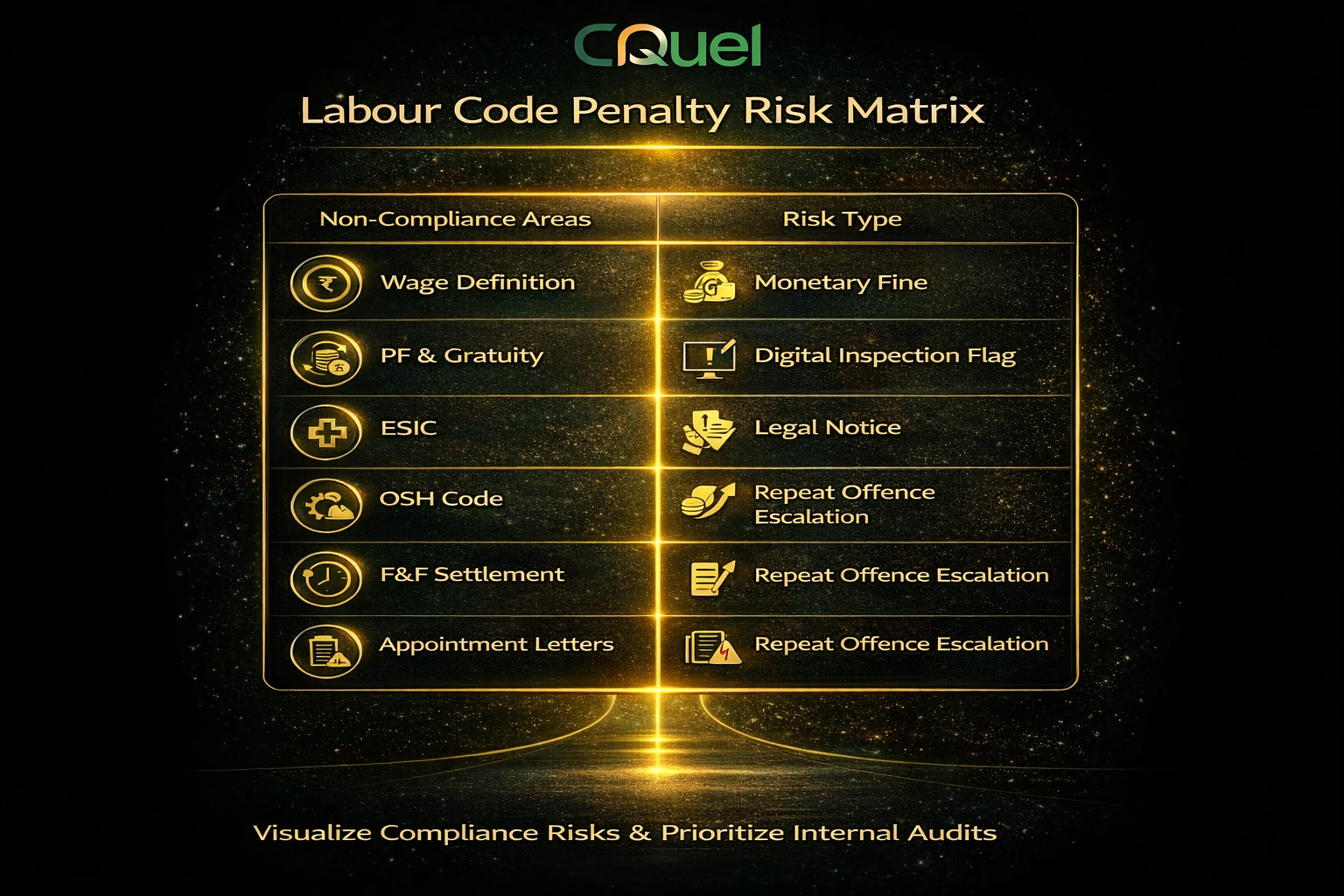
Non-compliance under the four labour codes can result in:
- Monetary penalties
- Compounded offences
- Legal prosecution in serious cases
- Business disruption during inspections
Let’s break this down clearly.
Monetary Penalties Under Labour Codes
Across the four labour codes, penalties have been rationalized but made more enforceable.
Depending on the violation, penalties may apply for:
- Non-payment of minimum wages
- Violation of wage definition norms
- Delay in 2-day F&F settlement
- Failure to issue mandatory appointment letters
- Non-compliance with OSH Code requirements
- Failure to deposit statutory deductions under the new labour codes
Fines can range from:
- ₹10,000 for minor procedural defaults
- ₹50,000 to ₹1,00,000 for serious violations
- Higher penalties for repeat offences
Repeated non-compliance can attract enhanced penalties and legal consequences.
The message is clear: Compliance is no longer optional; it is enforceable accountability.
Criminal Liability in Severe Cases
In cases involving:
- Willful non-payment of wages
- Obstruction of labour inspection
- Major OSH safety violations
- Repeated violation of the labour compliance India norms
Authorities may initiate prosecution proceedings.
While imprisonment provisions exist for extreme cases, most businesses face monetary penalties and reputational damage first.
But even a single prosecution notice can:
- Trigger additional inspections
- Impact investor confidence
- Affect government tender eligibility
This is why proactive labour compliance audit checklist implementation is essential.
Digital & Risk-Based Labour Inspections
One of the biggest 2025–2026 shifts is digitalisation.
Inspections are now increasingly:
- Risk-based
- Web-enabled
- Document-driven
- Data-backed
This means:
- Random inspections are reduced
- High-risk employers are prioritised
- Digital record inconsistencies trigger scrutiny
If your HR payroll compliance systems are not aligned with:
- Wage definition rules
- PF recalculations
- ESIC applicability
- State-wise OSH code compliance
You may be flagged during digital review.
In 2026, labour inspections in India are less about surprise visits and more about document intelligence.
Why Early Compliance Reduces Risk
Most penalties happen not because businesses intend to violate laws
but because:
- Payroll was not restructured properly
- Wage definition changes were misunderstood
- Appointment letter formats were outdated
- State-specific rules were ignored
This is why your labour code implementation roadmap must include:
- Quarterly compliance review
- Payroll restructuring audit
- ESIC and PF reconciliation
- Internal labour compliance training
Prevention costs less than a penalty.
Quick Risk Summary
If you ignore compliance updates, you risk:
- Financial penalties
- Employee disputes
- Legal notices
- Operational disruption
- Reputation damage
If you prepare properly, you gain:
- Audit-ready compliance
- Smooth inspections
- Predictable payroll impact
- Stronger HR governance
Frequently Asked Questions (FAQ)
1. How do the new labour codes affect payroll?
The new labour codes significantly impact payroll structuring in India.
The biggest change is the new wage definition, which requires that basic pay must be at least 50% of total remuneration. If allowances exceed 50%, the excess will be added back to wages for PF, gratuity, and bonus calculation.
This means companies may need to:
- Restructure salary components
- Recalculate statutory deductions
- Adjust PF and gratuity contributions
- Review CTC vs take-home balance
Payroll systems must now align with the updated wage definition under the Code on Wages and the Social Security Code.
2. What are the four labour codes in India?
The four labour codes consolidate 29 central labour laws into four simplified frameworks:
- Code on Wages (2019)
- Industrial Relations Code (2020)
- Social Security Code (2020)
- Occupational Safety, Health and Working Conditions (OSH) Code (2020)
Together, they regulate:
- Wages
- Industrial disputes
- Social security benefits
- Workplace safety and health standards
These reforms aim to simplify labour compliance requirements in India.
3. What is the new wage definition under the labour codes?
The new wage definition standardises how wages are calculated.
Key rule:
Basic pay must be at least 50% of total remuneration.
If allowances exceed 50%, the excess is added back to wages for calculating:
- PF
- Gratuity
- Bonus
- Other statutory benefits
This change directly affects payroll restructuring under labour codes.
4. Are annual health check-ups mandatory under the OSH Code?
Yes, under the OSH Code, annual health check-ups are mandatory for certain categories of employees.
Employers must:
- Provide periodic medical examinations
- Bear the cost of such health check-ups
- Maintain health records
Applicability may vary depending on establishment type and state-wise OSH code compliance rules.
5. How will PF calculation change under the new labour codes?
PF contributions may increase due to the 50% wage rule.
If basic salary is increased to meet compliance:
- Employer PF contribution increases
- Employee PF deduction increases
- Overall retirement corpus may grow
Payroll teams must reassess PF calculation to ensure statutory deductions under the new labour codes are accurate.
6. How should companies restructure salaries under the labour codes?
Companies should:
- Ensure basic pay is at least 50% of total salary
- Reduce excessive allowances
- Evaluate the impact on CTC and take-home pay
- Run payroll simulations before implementation
Salary restructuring should be done carefully to avoid sudden employee dissatisfaction.
7. What must appointment letters include under the OSH Code?
Under the OSH Code, employers must issue mandatory appointment letters to all employees.
Appointment letters should include:
- Job role and designation
- Wage details
- Working hours
- Leave entitlements
- Workplace location
- Terms of employment
This is now a compliance requirement, not a best practice.
8. Does ESIC apply to all establishments under the new codes?
The Social Security Code expands ESIC applicability.
Key changes include:
- Wider coverage thresholds
- Potential PAN-India ESIC expansion
- Inclusion of gig and platform workers
However, applicability still depends on:
- Employee count
- Wage limits
- State notifications
Businesses must validate ESIC applicability under labour codes carefully.
9. What is the difference between minimum wages and floor wages?
Minimum wage is the state-level wage fixed for specific employment categories.
The national floor wage is a baseline wage fixed by the Central Government. States cannot set minimum wages below the floor wage.
This ensures wage uniformity across labour compliance India frameworks.
10. Is a 2-day full and final settlement mandatory?
Yes.
Under the Industrial Relations Code, employers must complete a full and final settlement within 2 days of employee separation.
This includes:
- Salary dues
- Leave encashment
- Bonus
- Other pending payments
This rule significantly impacts payroll closure processes.
11. What are the penalties for non-compliance under labour codes?
Penalties may include:
- Monetary fines
- Increased fines for repeat offences
- Legal prosecution in serious cases
- Digital inspection scrutiny
Non-compliance with wage definition, PF deposits, OSH standards, or F&F timelines can trigger penalties.
12. How to prepare for a labour law compliance audit?
To prepare for a labour compliance audit checklist review:
- Reassess wage structures
- Validate PF and ESIC calculations
- Update appointment letters
- Maintain health check-up records
- Prepare inspection document files
- Conduct labour code compliance training
Being audit-ready reduces inspection risk.
13. Who should attend labour code compliance training?
Compliance training should include:
- HR managers
- Payroll teams
- Finance heads
- Compliance officers
- Business owners
Training ensures the correct interpretation of labour law changes 2025 and prevents costly errors.
14. How do labour codes impact gratuity and bonus?
Since gratuity and bonus are linked to the wage definition:
- A higher basic salary may increase gratuity liability
- Bonus calculation may change
- Long-term employee benefit costs may rise
Employers must project the financial impact before restructuring.
15. Does OSH Code apply to IT/ITeS companies?
Yes.
The OSH Code applies to IT/ITeS companies if they meet:
- Employee thresholds
- Establishment criteria
IT companies must also comply with:
- Health and safety provisions
- Appointment letter mandates
- Working hour regulations
State-wise labour rules may add further requirements.
16. What documents are required during a labour inspection?
During a labour inspection in India, authorities may request:
- Wage registers
- PF and ESIC records
- Appointment letters
- Attendance records
- Health check-up records (if applicable)
- Standing orders (if required)
- Compliance training records
Maintaining digital records helps with inspection readiness.