


Quick Summary
- What a factory compliance audit in India really includes in 2026
- Why labour inspections feel unpredictable even when documentation exists
- What a professional labour compliance consultant actually does
- How to evaluate the best labour consultant in India for factory compliance
- What makes a factory truly audit-ready in India
- How to prevent penalties through proactive labour law compliance audit
If you operate a factory in India, compliance is no longer just about maintaining registers. It is about managing risk, inspections, statutory deductions, contractor exposure, and documentation accuracy all together.
This guide helps you think about compliance as a structured system, not a last-minute reaction.
If we already maintain statutory registers and file returns, why do inspections still feel risky?
You may relate to this:
- Payroll runs on time
- PF and ESIC deposits are made
- Registers are maintained
- A consultant files monthly returns
Yet when a factory compliance audit in India happens:
- Inspectors ask for additional documentation
- Contractor compliance gaps surface
- Wage calculation mismatches are noticed
- Small technical errors trigger penalties
The issue is rarely intentional.
It is structured. Most factories treat compliance as periodic filing work. But regulators evaluate compliance as an integrated system.
That difference is where risk begins.
Why Labour Compliance Audits Matter More in 2026
In 2026, factory compliance in India is:
- More inspection-driven
- More digitally monitored
- More interconnected across departments
- Less tolerant of documentation gaps
With the increasing integration of digital records, statutory portals, and labour code implementation, compliance visibility has improved for authorities.
This means:
- Mismatched PF calculations can be detected faster
- Contractor non-compliance can trigger employer scrutiny
- Wage definition errors can lead to structured penalties
- Missing documentation can escalate quickly
A structured labour compliance audit services India approach is no longer optional.
It is preventive governance.
What This Article Will Help You Do
Instead of simply listing services, this guide is built to help you:
- Understand what is included in a factory labour law audit service
- Learn how to conduct a labour compliance audit in India step-by-step
- Identify common labour compliance audit violations
- Build a strong compliance audit checklist for factories
- Choose the right labour consultant for compliance audit in India
- Prepare for inspections without stress
Whether you are:
- A factory owner
- HR head
- Compliance manager
- Operations leader
- Manufacturing unit director
This guide is designed to give you clarity in plain language, not legal complexity.
Compliance Is No Longer a Filing Task, It’s Risk Management
In 2026, factory compliance in India is not just about:
- Filing statutory returns
- Maintaining registers
- Displaying notices
It is about:
- Labour compliance risk assessment India
- Workplace compliance audit alignment
- Contractor governance
- Payroll accuracy validation
- Safety and statutory documentation consistency
- Audit-ready compliance India systems
A true independent labour compliance audit in India evaluates whether your factory can withstand:
- Routine inspection
- Surprise audit
- Legal scrutiny
- Contractor dispute
- Wage claim
The right consultant doesn’t just check documents.
They assess exposure.
What Is Included in a Factory Compliance Audit in India?
When we ask, “What is included in a factory compliance audit?”
They often expect a short checklist.
But a proper factory compliance audit in India is not just a document review.
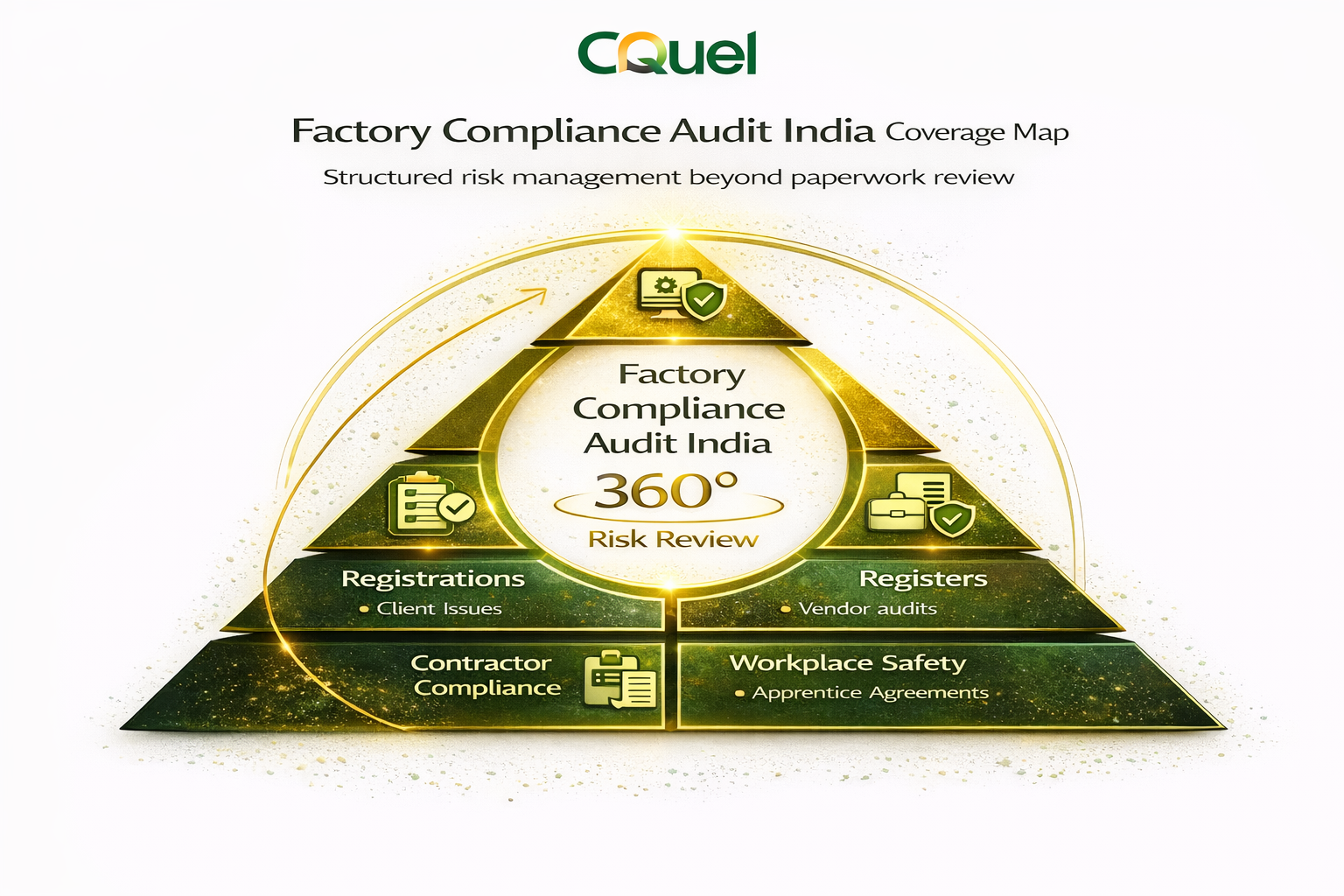
It is a structured evaluation of whether your factory is legally aligned across payroll, labour laws, statutory filings, safety compliance, and contractor management.
If you’re working with a serious labour compliance consultant, the audit should cover five core pillars.
-
Statutory Registration & License Verification
Every factory must maintain valid and updated statutory registrations.
A professional labour law compliance audit verifies:
- Factory license validity under the Factories Act
- Shops & Establishment registration (if applicable)
- CLRA registration (if contract labour is engaged)
- ESIC & EPFO registration status
- Professional Tax registration
- Labour Welfare Fund registration
- Pollution Control Board approvals (where applicable)
Common violation:
Licenses are valid on paper but are missing amendments for the increased workforce or additional contractors.
A legal compliance audit in India ensures registrations reflect actual operations not outdated data.
-
Payroll & Statutory Deductions Review
Payroll is the most sensitive area in a labour compliance audit services India engagement.
A compliance audit checks:
- Minimum wage adherence (including category-wise rates)
- Overtime calculation accuracy
- PF calculation accuracy (basic wage structure validation)
- ESIC contribution correctness
- Bonus eligibility & payout compliance
- Gratuity eligibility tracking
- Leave encashment compliance
This is where many factories fail without realizing it.
For example:
- Incorrect wage split structures
- Allowances reduce PF liability artificially
- ESIC applied inconsistently
- Overtime miscalculated
A strong labour compliance risk assessment in India highlights these gaps before inspectors do.
-
Registers, Records & Documentation Audit
Factories must maintain multiple statutory registers.
A factory labour law audit services review includes:
- Muster rolls
- Wage registers
- Overtime registers
- Leave registers
- Contractor labour registers
- Accident registers
- Bonus and gratuity records
The audit checks:
- Whether formats are legally compliant
- Whether entries match payroll records
- Whether digital registers are backed by proof
- Whether contractor registers are maintained separately
Common violation:
Records are maintained, but are inconsistent with actual payroll data.
That mismatch is often where penalties arise.
-
Contractor & CLRA Compliance Review
Factories using contractors face higher audit exposure.
A proper labour consultant for compliance audit India will verify:
- Contractor licenses
- Wage payment proof for contract labour
- PF & ESIC deposits by contractors
- Attendance reconciliation
- Principal employer compliance responsibility
Many factories assume contractor compliance is the contractor’s responsibility alone.
Legally, that assumption is risky.
If contractor violations occur, principal employers can be held accountable.
That is why contractor review is a critical part of any factory compliance audit checklist in India.
-
Workplace & Safety Compliance Audit
A complete workplace compliance audit also evaluates:
- Safety committee formation
- Safety training records
- Fire safety certifications
- Health & hygiene standards
- Medical examination records (where applicable)
- PPE compliance documentation
ISO & factory compliance audit in India often overlap here, but statutory compliance and ISO compliance are not identical.
A statutory audit checks legal adherence. ISO checks system quality.
You need both, but for different reasons.
-
Inspection Readiness & Risk Assessment
The final stage of a strong, independent labour compliance audit in India is exposure mapping.
This includes:
- Identifying high-risk non-compliance areas
- Estimating potential penalty exposure
- Highlighting repeat violation patterns
- Recommending corrective actions
- Providing audit-ready documentation guidance
This is what separates reactive consultants from strategic compliance advisors.
What a Labour Compliance Consultant Actually Does
A skilled labour law expert in India doesn’t just review documents.
They:
- Interpret jurisdiction-specific compliance
- Identify hidden exposure in payroll structures
- Conduct compliance audit reporting templates in India
- Recommend corrective restructuring
- Support inspection handling
- Provide labour compliance training services in India
In short, they reduce risk, not just prepare files.
Factory Compliance Audit Scope Summary
| Audit Area | What Is Checked | Why It Matters |
| Registrations & Licenses | Validity & alignment | Avoid technical violations |
| Payroll & Deductions | Wage & statutory accuracy | Prevent financial penalties |
| Registers & Records | Legal format & consistency | Avoid inspection objections |
| Contractor Compliance | CLRA & statutory deposits | Reduce principal employer liability |
| Workplace Safety | Health & safety compliance | Prevent prosecution & fines |
| Risk Assessment | Exposure & corrective plan | Build audit-ready compliance in India |
How to Conduct a Labour Compliance Audit in India (Step-by-Step Framework)
If you’re asking, “How to conduct a labour compliance audit in India?”
You’re already thinking the right way.
A proper labour compliance audit in India is not a last-minute file arrangement before inspection.
It is a structured, repeatable process designed to identify compliance gaps before they become penalties.
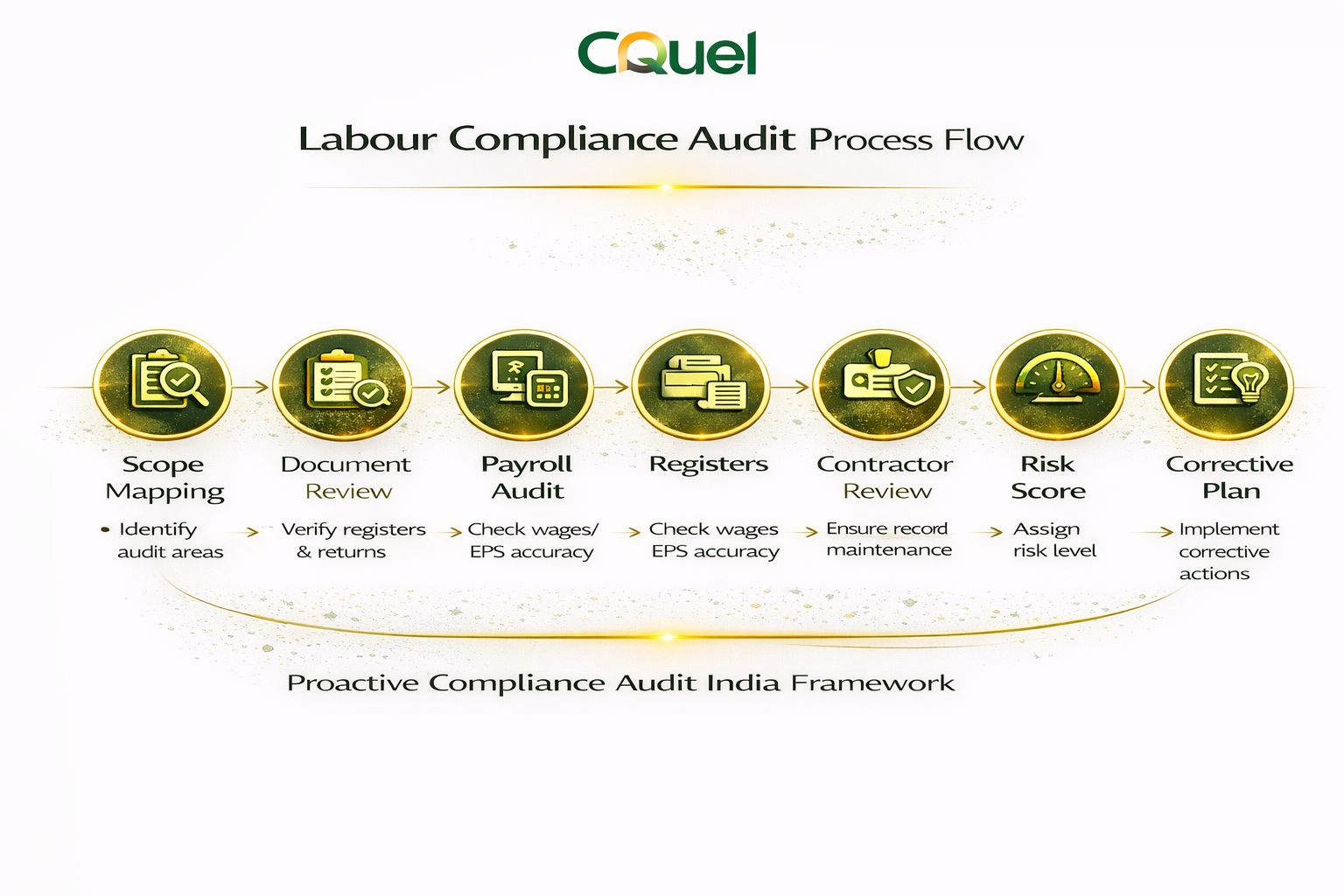
Below is the practical framework followed by experienced labour compliance consultants and professional factory labour law audit services teams.
Step 1: Define Audit Scope & Legal Applicability
Before reviewing documents, you must answer:
- Which Acts apply to your factory?
- Which state jurisdiction governs you?
- How many employees (permanent + contract) are active?
- What risk areas are highest based on industry?
For example:
- Manufacturing units → Factories Act + CLRA + PF + ESIC
- Units with >20 contract workers → CLRA registration mandatory
- Wage thresholds affect ESIC applicability
A qualified labour law compliance consultant in India first maps:
✔ Central labour laws
✔ State amendments
✔ Industry-specific requirements
✔ Contractor liabilities
Without this scope mapping, audits become incomplete.
Step 2: Collect & Verify Statutory Registrations
Next comes document verification.
A structured statutory compliance audit in India checks:
- Factory license validity
- Amendment approvals (if the workforce increased)
- Contractor licenses
- PF & ESIC registration
- Labour Welfare registrations
- Professional Tax compliance
Common mistake:
Registrations exist but are outdated or not amended.
A professional compliance audit in India identifies this mismatch early.
Step 3: Conduct Payroll & Wage Structure Audit
This is where most compliance exposure lies.
A proper labour law compliance audit reviews:
- Minimum wage compliance (category & state-wise)
- Overtime calculation accuracy
- Basic wage structure vs statutory norms
- PF contributions based on eligible components
- ESIC deductions & thresholds
- Bonus and gratuity eligibility tracking
Many factories fail because:
- Allowance-heavy salary structures reduce PF artificially
- Overtime is calculated incorrectly
- ESIC coverage is inconsistent
This is why labour compliance risk assessment in India must include payroll restructuring analysis, not just deduction checks.
Step 4: Audit Registers & Statutory Records
Next comes physical and digital register review.
A complete factory compliance audit checklist should verify:
- Muster roll consistency
- Wage register accuracy
- Overtime register reconciliation
- Leave records
- Contractor attendance
- Accident registers
- Bonus & gratuity documentation
The auditor compares:
Register entries ↔ Payroll system ↔ Bank statements
Any mismatch becomes a red flag during labour inspections.
This step ensures your business remains audit-ready in India.
Step 5: Contractor & CLRA Risk Evaluation
If your factory engages contract labour, this is critical.
A professional labour consultant for compliance audit India checks:
- Contractor license validity
- PF & ESIC deposits by contractor
- Wage disbursement proofs
- Attendance reconciliation
- Principal employer compliance responsibility
Legal risk reminder:
Even if the contractor defaults, the principal employer can be held liable.
That’s why contractor compliance is a major pillar in factory labour law audit services.
Step 6: Workplace Compliance & Safety Review
A strong workplace compliance audit evaluates:
- Safety committee formation
- Fire safety certificates
- Medical check-up records
- PPE documentation
- Training registers
- Emergency evacuation procedures
Factories often pass documentation audits but fail practical compliance.
A good auditor checks both.
Step 7: Risk Scoring & Compliance Gap Report
The final stage of a professional independent labour compliance audit in India includes:
- Risk grading (Low / Moderate / High)
- Estimated penalty exposure
- Repeat violation identification
- Corrective action roadmap
- Timeline for compliance closure
This is where audit becomes strategic, not clerical.
Step 8: Corrective Action & Compliance Training
After identifying gaps, the real work begins.
A proactive compliance approach includes:
- Payroll restructuring
- License amendment filing
- Contractor correction notices
- Documentation standardization
- Labour compliance training services in India
- Digital tools for compliance audit India implementation
This transforms audit into long-term compliance stability.
Practical Audit Flow (Simplified)
- Scope mapping
- Registration verification
- Payroll compliance review
- Register reconciliation
- Contractor evaluation
- Safety inspection
- Risk reporting
- Corrective implementation
That’s how you conduct a proactive compliance audit in India, not just a defensive one.
Why Independent Audits Are Increasing
Many factories now opt for independent labour compliance audit India services because:
- Government inspections are becoming more data-driven
- Digital filings create audit trails
- Repeat violations increase penalty severity
- Corporate governance expectations are rising
Waiting for inspection is expensive.
Preparing before inspection is strategic.
Factory Compliance Audit Checklist India (Complete Audit-Ready Framework)
When people search for a factory compliance audit India checklist, what they really want to know is:
Are we truly audit-ready or just assuming we are?
A proper labour law compliance audit is not a document-counting exercise. It is a structured risk assessment of how your factory operates under Indian labour laws, including the Factories Act, new labour codes, PF, ESIC, CLRA, wage laws, and state-specific rules.
If you engage a professional labour compliance consultant for a compliance audit in India, this is the structure they will typically follow.
Why a Structured Audit Checklist Matters
Most compliance failures don’t happen because businesses ignore the law.
They happen because:
- Registers are partially updated
- Contractors are non-compliant
- Payroll calculations are inconsistent
- Safety documentation is outdated
- Inspection files are incomplete
According to guidance published by the Ministry of Labour & Employment, labour inspections now increasingly follow risk-based and digital selection frameworks rather than random checks. That means your factory must maintain audit-ready compliance in India at all times, not only when notice is received.
As labour law expert R. Venkataraman, former Labour Commissioner (cited in government advisory notes on compliance governance), has emphasised:
“Compliance is not a one-time certification; it is a continuous control system within the establishment.”
That principle defines modern factory compliance audit best practices.
Complete Labour Compliance Audit Checklist for Factories (India)
Below is a structured, audit-ready compliance checklist for factories.
-
Statutory Registrations & Licenses
Every statutory compliance audit in India begins here.
✔ Valid Factory License
✔ Updated amendment approvals (capacity, workforce increase)
✔ CLRA Registration (if contract labour engaged)
✔ Contractor Labour Licenses
✔ PF Registration (EPFO)
✔ ESIC Registration
✔ Professional Tax Registration (state-specific)
✔ Shops & Establishment (if applicable to offices attached to the factory)
Common violation: License workforce capacity exceeded without amendment.
-
Wage & Payroll Compliance
This section addresses core factory labour law audit services review areas.
✔ Wage register (as per state rules/wage code formats)
✔ Attendance and muster roll
✔ Overtime calculation records
✔ Minimum wage compliance verification
✔ National floor wage India reference compliance
✔ Statutory deductions (PF, ESIC, PT, LWF)
✔ Bonus calculation records
✔ Payslips issued properly
✔ Salary disbursement proof (bank transfer records)
Common violation: Incorrect overtime calculation or non-alignment with revised wage definitions.
If you’re asking, “How to conduct a labour compliance audit in India?” Payroll validation is always one of the highest-risk sections.
-
PF & ESIC Compliance Records
For any labour compliance risk assessment in India, this is critical.
✔ Monthly PF ECR filings
✔ PF challan payment proofs
✔ ESIC contribution filings
✔ UAN activation tracking
✔ Exit & transfer documentation
✔ Employee coverage threshold validation
Common violation: Contract labour not properly covered under PF/ESIC.
This is where many factories face penalties after a legal compliance audit in India.
-
Contract Labour & Vendor Compliance
If your factory engages contractors, this section is high-risk.
✔ Contractor agreements
✔ Contractor wage register verification
✔ PF & ESIC remittance proofs from contractors
✔ Attendance reconciliation
✔ Labour supply contracts
✔ Form V issuance
✔ Principal employer oversight documentation
Common violation: Principal employer liability triggered due to contractor default.
A professional factory labour law consultant in India will always cross-check contractor compliance, not just your internal records.
-
Health, Safety & Factory Act Compliance
Under the Factories Act and OSH provisions:
✔ Safety officer appointment (if required by workforce size)
✔ Safety committee records
✔ Accident register
✔ Medical examination records
✔ Annual health check-up compliance (where applicable)
✔ Fire safety NOC
✔ Emergency evacuation plan
✔ Machine safety compliance documentation
Common violation: Incomplete accident reporting.
A structured workplace compliance audit always evaluates safety documentation alongside payroll compliance.
-
Statutory Registers & Returns
Every factory must maintain the required registers in the prescribed format.
✔ Muster roll
✔ Leave register
✔ Overtime register
✔ Wage register
✔ Deduction register
✔ Inspection book
✔ Annual return filing
✔ Half-yearly return (state-specific)
Common violation: Registers are maintained but not updated regularly.
A proper compliance audit checklist for factories ensures both availability and accuracy.
-
Inspection File Readiness
This is often overlooked.
An audit-ready factory maintains a single inspection file containing:
✔ All registrations
✔ Recent returns
✔ Challans
✔ Wage records
✔ Contractor documents
✔ Accident reports
✔ Board resolutions (if required)
If a labour inspector arrives, documentation should be immediately accessible.
-
Digital Tools for Compliance Audit India
Modern compliance audits increasingly use digital records.
✔ Payroll software integration
✔ PF & ESIC portal reconciliation
✔ Contractor digital documentation
✔ Automated compliance reminders
✔ Document management systems
Digital tools reduce risk and improve audit performance benchmarks.
What Are Common Labour Compliance Audit Violations?
Across India, some recurring issues appear during independent labour compliance audit reviews:
- Non-payment of minimum wages
• Overtime under-calculation
• PF & ESIC contribution gaps
• Contractor documentation mismatch
• License capacity violations
• Incomplete accident reporting
• Delayed statutory returns
Understanding these helps in proactive compliance audit India planning.
Factory Compliance Audit Best Practices
If you want to move from reactive compliance to proactive control:
✔ Conduct internal quarterly compliance review
✔ Perform annual independent labour audit
✔ Implement digital compliance tools
✔ Conduct labour compliance training services in India for HR
✔ Maintain contractor compliance tracking
✔ Document corrective action plans
This is what defines proactive compliance audit in India.
How Often Should Labour Compliance Audits Be Conducted?
For factories:
- Internal audit – Every 6 months
• Independent external audit – Annually
• Post-notice compliance review – Immediately
• After workforce expansion – Mandatory review
High-risk industries may require quarterly review cycles.
How to Fix Non-Compliance Found in a Factory Audit?
If your audit reveals gaps:
Identify root cause (documentation vs structural error)
Rectify the statutory filing immediately
Pay pending dues with applicable interest
Update internal SOPs
Train HR & payroll teams
Implement preventive compliance monitoring
Corrective action documentation is critical in case of re-inspection.
Why This Checklist Matters
A labour compliance audit is not about passing inspection.
It is about:
- Reducing financial penalties
• Preventing criminal liability
• Improving workforce governance
• Strengthening factory compliance India standards
• Protecting leadership accountability
As emphasised in labour governance best-practice frameworks published by government advisory committees:
“Documentation without internal control systems does not constitute compliance.”
True compliance is structural, not superficial.
How to Choose the Best Labour Consultant for Factory Compliance in India
When businesses search for the best labour consultant in India, the real concern behind that search is simple:
Who can actually protect us from compliance risk, not just prepare files?
Choosing the right labour compliance consultant for a factory is not about hiring someone who “knows the law.”
It is about selecting a partner who understands:
- Factory compliance audit India requirements
- State-wise labour enforcement realities
- Payroll structuring under Indian labour laws
- Contractor compliance risks
- Inspection handling strategy
- Post-audit corrective action planning
A factory operates in a high-risk compliance environment. The wrong consultant may help you pass one inspection but fail to build audit-ready compliance in India as a system.
Let’s break down what truly matters.
-
Understand the Role of a Labour Compliance Consultant
Before choosing, ask:
What does a labour compliance consultant actually do?
A qualified labour law expert in India should:
✔ Conduct a complete labour law compliance audit
✔ Perform labour compliance risk assessment in India
✔ Review payroll & statutory deductions
✔ Audit contractor compliance records
✔ Validate statutory registers & filings
✔ Identify exposure areas and penalty risks
✔ Create corrective action plans
✔ Support during labour inspections
✔ Provide labour compliance training services in India
✔ Help implement proactive compliance audit in India systems
If the consultant only provides documentation templates, that is not compliance consulting; that is clerical support.
Real consulting focuses on control systems and risk mitigation.
-
Look for Factory-Specific Experience (Not Generic HR Advice)
Factory compliance in India is different from:
- Corporate office compliance
- IT company compliance
- Retail shop compliance
Factories deal with:
- Factories Act & OSH requirements
- Safety audits
- Contractor labour management
- Shift systems & overtime complexities
- License capacity approvals
- On-site inspections
Ask:
- Have they handled factory labour law audit services before?
• Do they understand the inspection procedure?
• Have they managed ISO & factory compliance audit India scenarios?
• Can they conduct an independent labour compliance audit in India?
Experience matters because enforcement patterns vary by industry.
-
Evaluate Their Labour Compliance Audit Methodology
The best labour consultant for compliance audit India will not “check files casually.”
They will follow a structured audit framework:
- Registration validation
• Wage & payroll verification
• PF & ESIC compliance review
• Contractor liability audit
• Health & safety compliance check
• Statutory return validation
• Risk grading & exposure scoring
• Corrective action roadmap
Ask them directly:
“How do you conduct a labour compliance audit in India?”
If the answer is vague, that’s a red flag.
Professional labour audit services must follow documented audit methodology.
-
Check Their Risk Mitigation Capability
Many consultants identify problems.
Few help fix them.
Ask:
- Can you help restructure payroll under compliance risk?
• Can you assist in responding to show-cause notices?
• Do you provide compliance audit reporting templates in India?
• Do you support during inspections?
• Do you offer compliance audit solutions in India beyond reports?
A true labour consultant for compliance audit India focuses on solutions, not just findings.
-
Digital & Reporting Capabilities Matter
Modern labour audits are increasingly data-driven.
The right consultant should:
✔ Use digital tools for compliance audit in India
✔ Reconcile payroll with statutory filings
✔ Generate structured compliance audit reporting templates in India
✔ Maintain audit-ready compliance India dashboards
✔ Benchmark labour audit performance India metrics
Manual Excel review alone is no longer sufficient in complex factory environments.
Digital visibility reduces recurring compliance risk.
-
Understand Cost But Don’t Choose on Price Alone
Many ask:
“How much does a factory compliance audit cost in India?”
Costs vary based on:
- Workforce size
• Number of contractors
• State-specific laws
• Audit depth
• On-site visits required
• Ongoing advisory support
However:
Choosing the cheapest consultant can increase penalty exposure.
Non-compliance penalties under labour laws can include:
- Monetary fines
• Prosecution of management
• License suspension
• Backdated statutory recovery
The cost of poor consulting is always higher than professional advisory services.
-
Look for a Preventive Compliance Approach
The best labour consultant in India will focus on:
✔ Proactive compliance audit of India systems
✔ Continuous compliance monitoring
✔ Labour compliance training services in India
✔ Internal compliance control mechanisms
✔ Risk-based audit cycles
✔ Governance alignment
They help you move from:
“Inspection-ready” to “Always compliant.”
-
Ask These 10 Questions Before Hiring
To choose the best labour consultant for factory compliance:
- Do you specialise in factory compliance audits in India?
- What is your audit methodology?
- Can you conduct a labour compliance risk assessment in India?
- How do you evaluate contractor compliance?
- Do you provide compliance audit reporting templates in India?
- Do you support inspection representation?
- What digital tools for compliance audit in India do you use?
- Do you offer labour compliance training services in India?
- How often do you recommend labour audits?
- How do you handle post-audit corrective action?
If answers are structured and confident, you likely have the right partner.
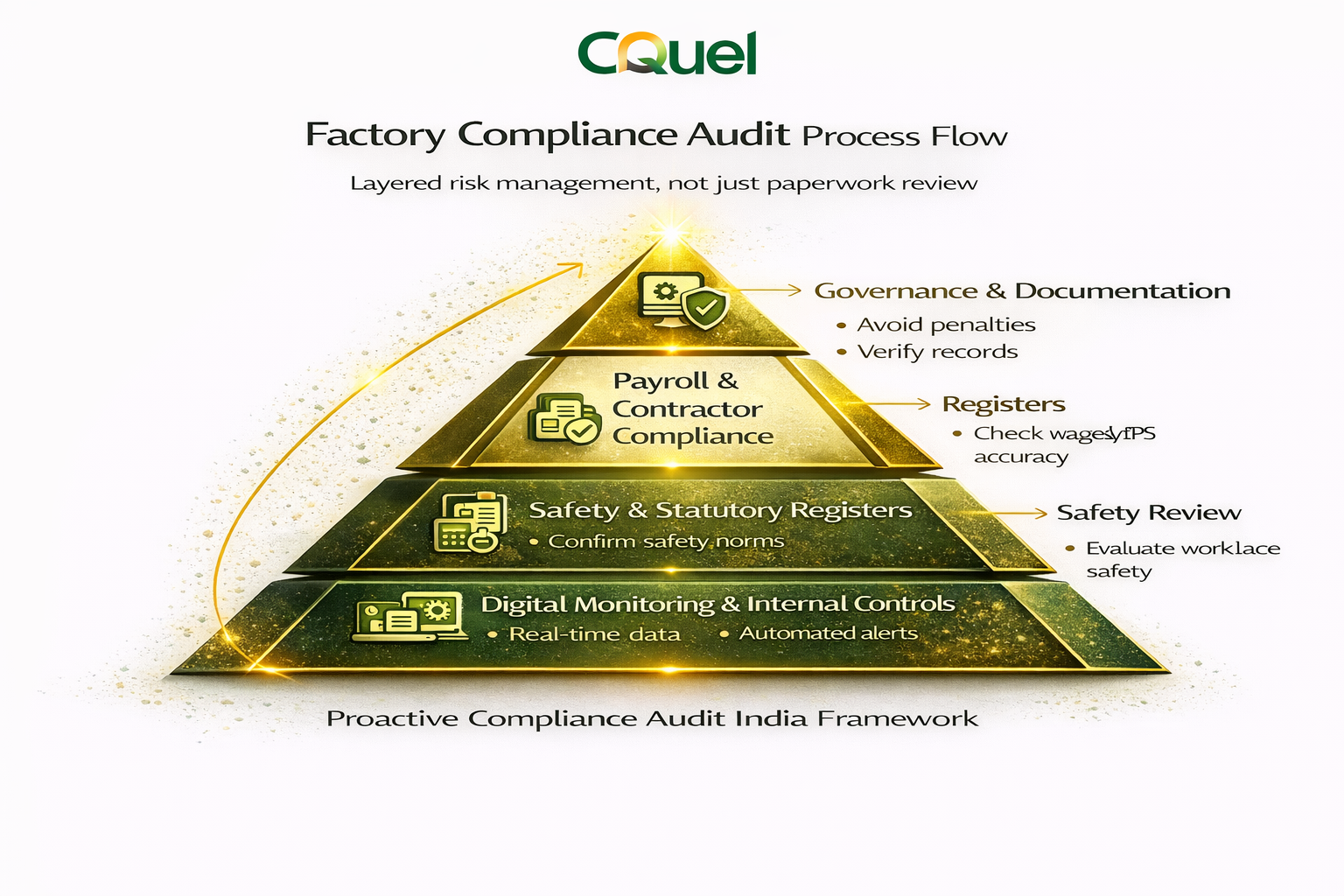
What Separates a Good Consultant from the Best?
A good consultant:
- Checks documents
• Points out gaps
• Submits report
The best labour consultant in India:
- Builds a compliance control system
• Reduces legal exposure
• Aligns payroll with the statutory framework
• Strengthens contractor governance
• Prepares management for inspections
• Improves audit performance benchmarks
• Ensures audit-ready compliance in India
Factory compliance is not paperwork.
It is risk management.
The Bottom Line
If you are serious about:
- Passing inspections confidently
• Avoiding penalties
• Reducing labour compliance risk
• Strengthening governance
• Creating proactive compliance audit in India systems
Then choosing the right labour compliance consultant is not optional.
It is strategic.
Common Labour Compliance Audit Violations in Indian Factories
When companies search for labour audit services or a labour compliance consultant for factory compliance in India, it is usually after one of two events:
- An inspection notice has arrived
• A previous audit revealed serious non-compliance
Most violations in a factory compliance audit in India are not dramatic legal breaches.
They are operational gaps that accumulate over time.
The problem?
Small compliance gaps compound into large legal exposure.
If you want to build audit-ready compliance in India, you must understand where factories most commonly fail.
-
Wage & Payroll Violations
Payroll remains the most frequent area of non-compliance in a labour law compliance audit.
Common findings:
- Incorrect minimum wage calculation
• Improper wage structuring to reduce statutory contributions
• Overtime miscalculation
• Non-payment of double overtime rates
• Incorrect bonus calculation
• Delayed wage payment
• PF & ESIC mismatch with payroll data
Many factories underestimate how easily payroll errors are detected during a statutory compliance audit in India.
Auditors typically:
✔ Reconcile payroll registers
✔ Cross-check bank transfers
✔ Compare statutory returns
✔ Verify attendance vs wage sheets
If documentation and actual payment data do not match, the exposure is immediate.
-
Contractor Labour Compliance Failures
Contractor compliance is one of the highest-risk areas in factory labour law audit services.
Typical violations include:
- Unregistered contractors
• Missing contractor licenses
• Absence of wage registers
• PF/ESIC not deposited for contract workers
• Non-maintenance of muster rolls
• Non-payment of overtime
Under Indian labour laws, the principal employer remains liable.
This is why labour compliance risk assessment in India must always include contractor review.
Ignoring contractor documentation is one of the most expensive compliance mistakes factories make.
-
Statutory Register & Documentation Gaps
Many audits reveal incomplete or outdated records.
Frequently missing documents:
- Wage registers
• Attendance records
• Leave records
• Inspection registers
• Accident registers
• Contractor agreements
• Factory license renewals
In a legal compliance audit in India, missing documentation is treated as non-compliance even if payments were made correctly.
Documentation proves compliance.
Without records, compliance cannot be defended.
-
Factory Safety & Workplace Compliance Issues
Under workplace compliance audit standards and factory regulations, safety remains a high-priority inspection area.
Common violations:
- Inadequate safety signage
• Missing safety training records
• Improper PPE distribution records
• Unreported workplace accidents
• Expired safety certifications
• No documented health & safety policy
Factories often focus on payroll compliance but overlook safety documentation, a mistake that can result in severe penalties.
-
Registration & License Violations
Audit reports often flag:
- Expired factory licenses
• Missing labour registrations
• Incorrect workforce declarations
• Failure to update license capacity
• Non-display of statutory notices
These may seem administrative, but during an inspection, they trigger deeper investigation.
-
Non-Compliance in Working Hours & Overtime
Factories frequently face violations related to:
- Excessive working hours
• Non-maintenance of shift schedules
• Overtime beyond statutory limits
• Improper compensatory off-tracking
Auditors examine attendance logs carefully during factory compliance audit best practices reviews.
If working hour patterns indicate systemic non-compliance, penalties escalate quickly.
-
Failure to Conduct Regular Labour Audits
One of the most overlooked violations is simply:
No internal compliance review process.
Companies often wait for inspection notices before conducting a proactive compliance audit in India.
Regular labour compliance audit services in India reduce risk dramatically by:
✔ Identifying recurring issues
✔ Correcting payroll structure gaps
✔ Updating registers
✔ Validating contractor compliance
✔ Benchmarking labour audit performance in India
Without periodic review, violations multiply silently.
-
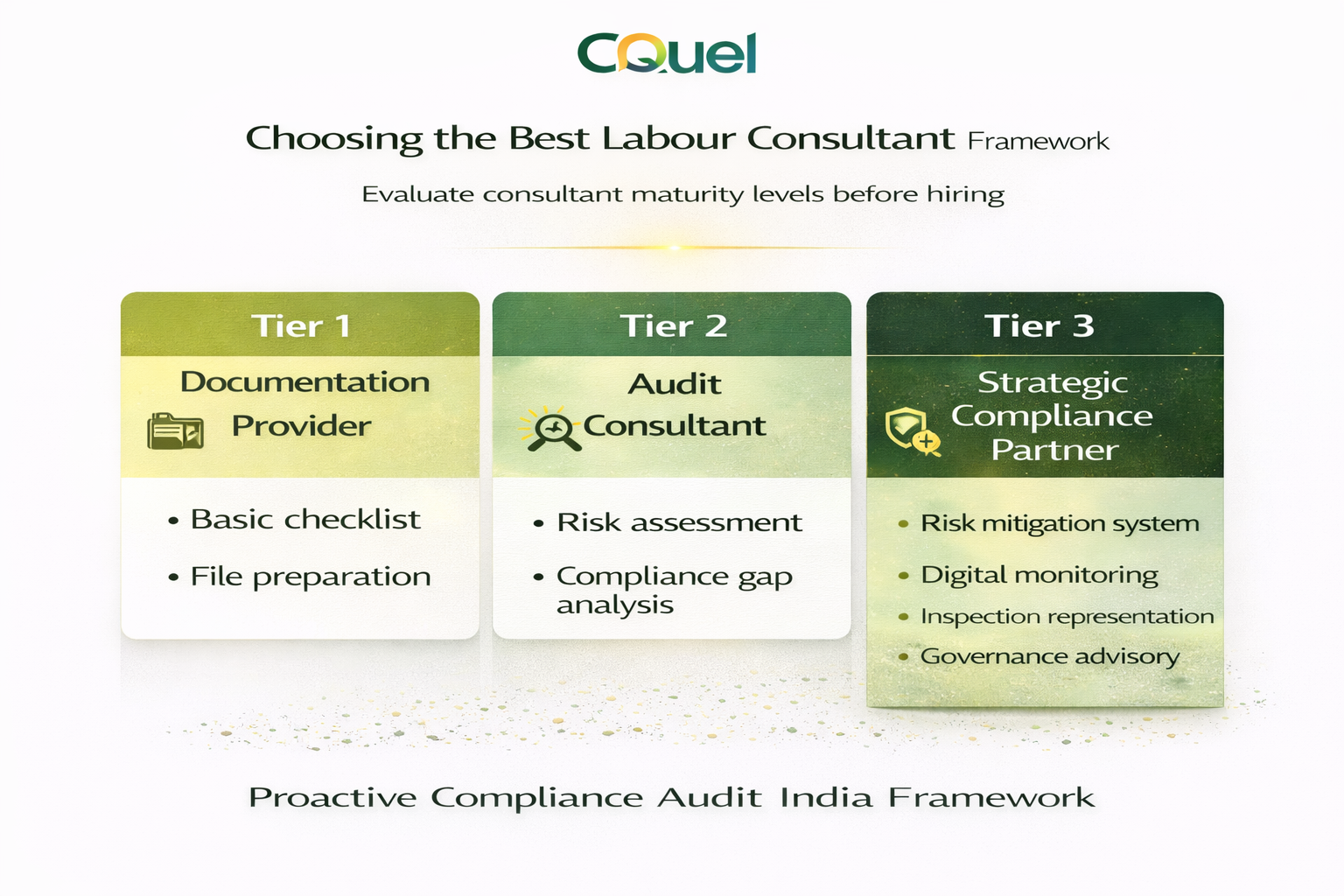
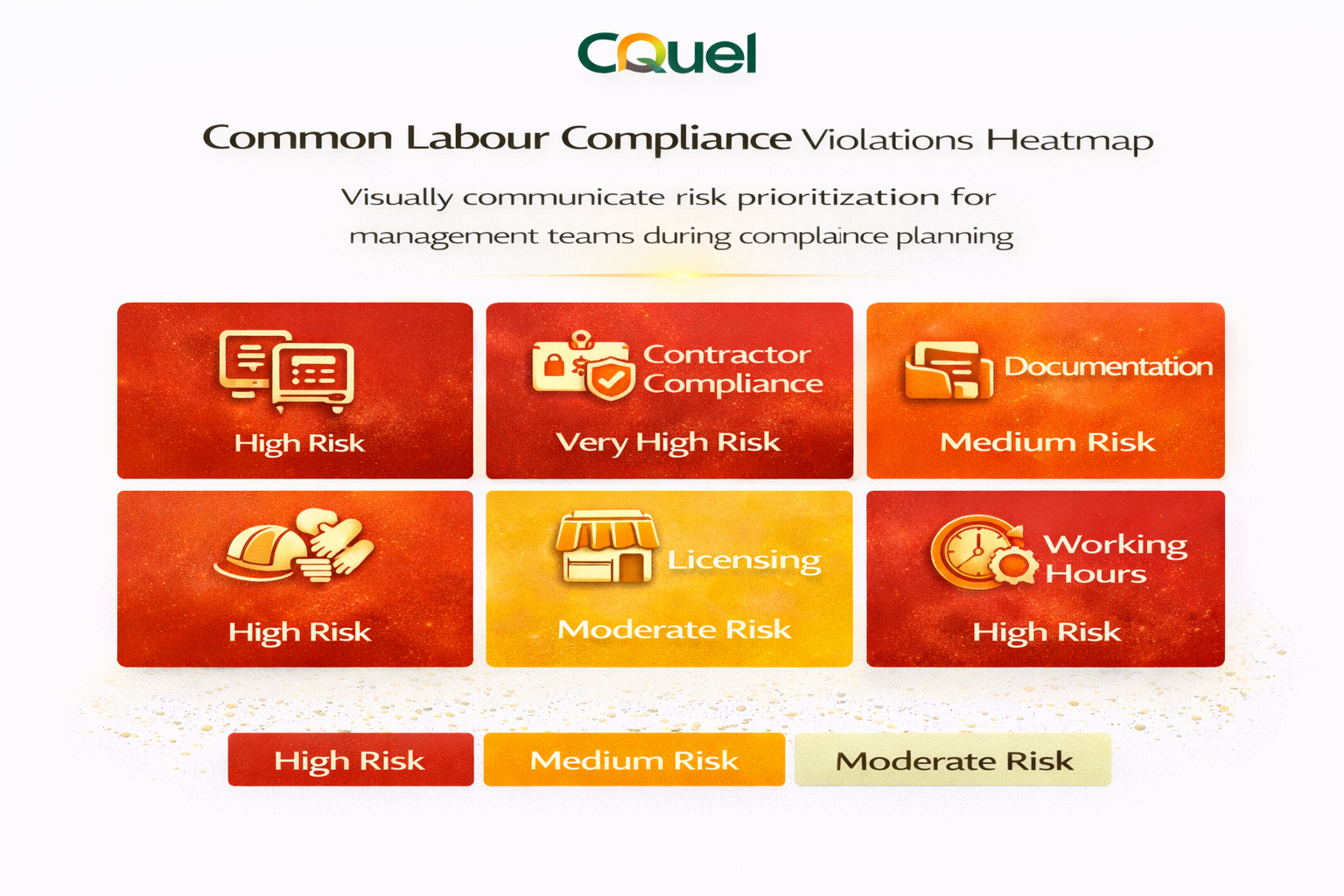
Common Violations Snapshot (Quick View Table)
| Violation Area | Risk Level | Typical Consequence |
| Payroll errors | High | Monetary penalties + backdated recovery |
| Contractor non-compliance | Very High | Principal employer liability |
| Missing registers | Medium–High | Inspection escalation |
| Safety documentation gaps | High | Operational shutdown risk |
| License expiry | Medium | Legal notice + penalty |
| Overtime violations | High | Back wages + fines |
What Are the Consequences of These Violations?
If gaps are not corrected after audit findings, consequences may include:
- Monetary penalties
• Backdated statutory recovery
• Show-cause notices
• Prosecution of directors/occupiers
• Suspension of factory operations
• Reputational damage
This is why hiring the best labour consultant in India and implementing a structured compliance audit checklist for factories is essential.
How to Fix Non-Compliance Found in a Factory Audit
If violations are identified:
- Conduct an immediate risk assessment
- Rectify payroll errors
- Update statutory registers
- Regularise contractor documentation
- File corrective returns if required
- Implement digital compliance tracking
- Conduct labour compliance training services in India
The goal is not just fixing past errors but preventing recurrence.
The Real Insight
Most factory audit failures are not caused by ignorance.
They are caused by:
- Poor documentation systems
• Weak internal compliance ownership
• No periodic statutory compliance audit in India
• Reactive instead of proactive compliance management
Factories that treat compliance as governance, not paperwork, rarely face severe penalties.
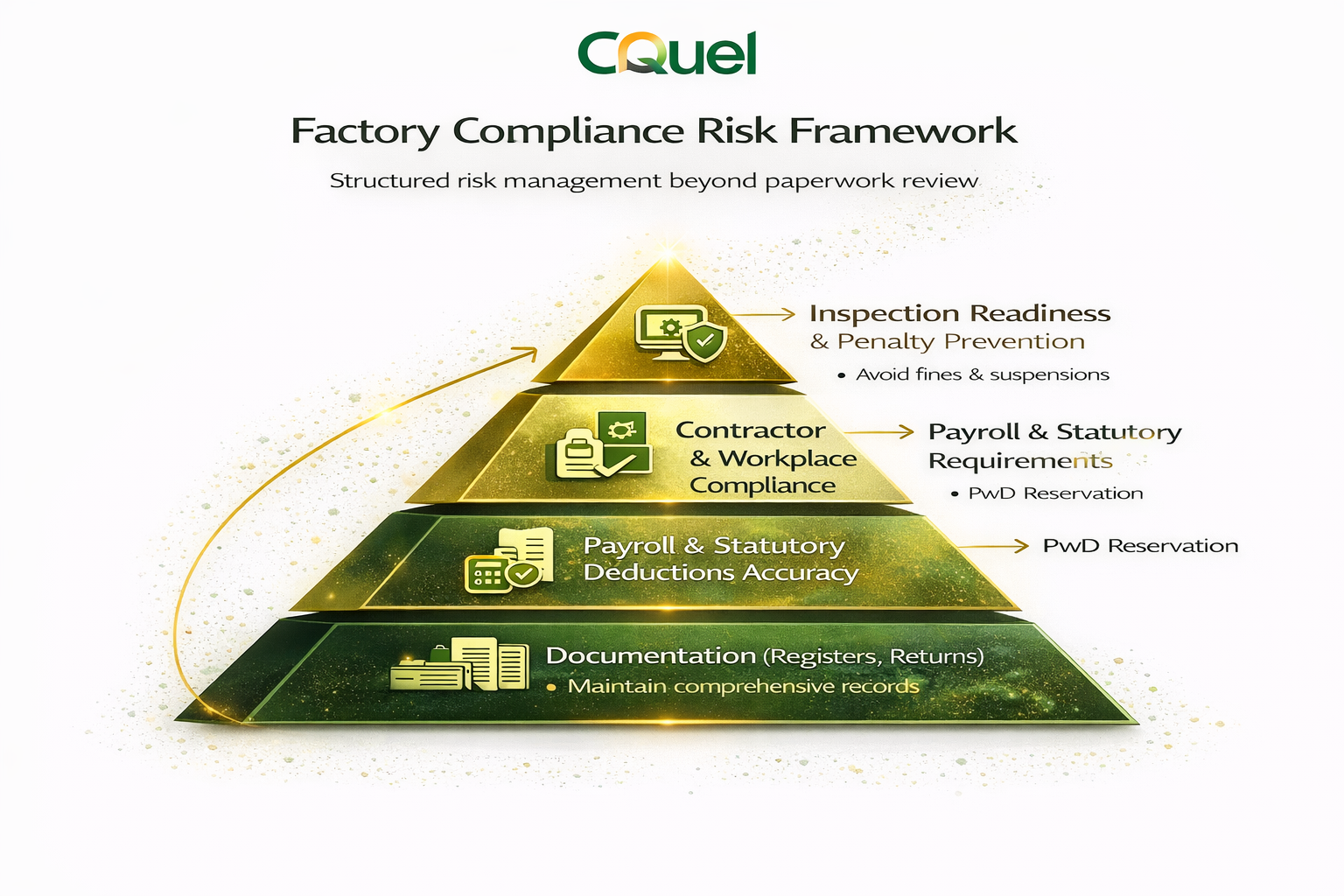
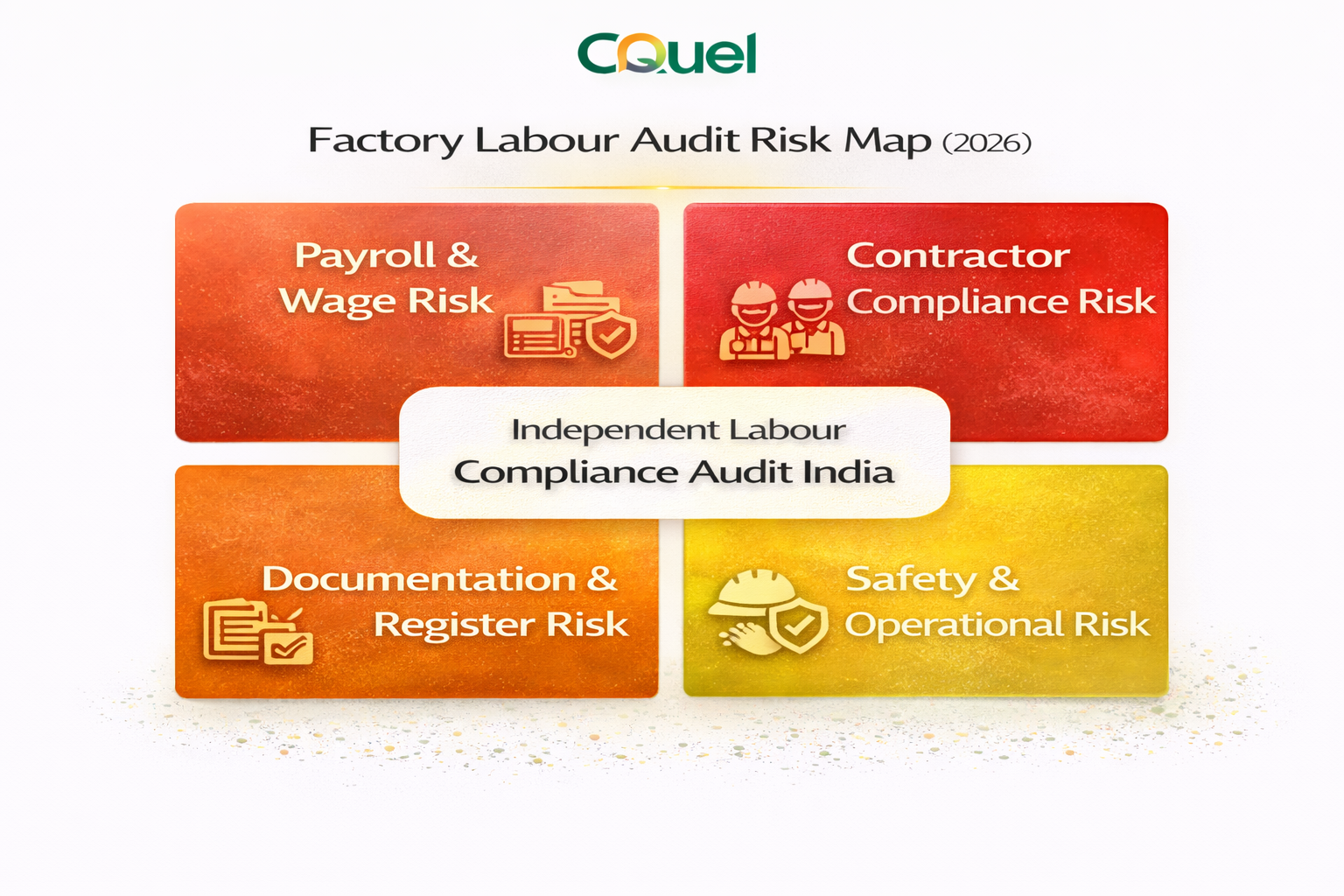
Factory Compliance Audit Risk Framework (2026)
Most factories don’t fail compliance because they “don’t know the law.”
They fail because:
- Risks were underestimated
• Contractor exposure was ignored
• Payroll deviations compounded silently
• Documentation was treated as paperwork, not evidence
• Internal reviews were cosmetic, not forensic
If you want to work with the best labour consultant in India, you need to understand what a serious factory compliance audit actually examines.
This is not a checklist exercise.
It is a risk assessment system.
Let’s break it down the way top factory labour law consultants do.
-
High-Risk Audit Zones in Manufacturing Units
In 2026, inspectors and independent labour compliance audit India teams focus on high-exposure areas first.
These include:
• Contract Labour Deployment Risk
- Mismatch between contractor registers and attendance
- EPF/ESI payment gaps
- Principal employer liability exposure
• Overtime & Shift Violations
- Excess hours beyond statutory limits
- Improper overtime calculation
- Weekly rest compliance failures
• Wage Structure Manipulation
- Basic pay is artificially suppressed
- Allowance-heavy structures to reduce PF liability
- Non-compliance with new wage definition standards
• Statutory Register Integrity
- Incomplete digital records
- Backdated entries
- Inconsistent wage slips
Factories with 100+ workforce face amplified scrutiny under digital inspection systems.
A factory compliance audit in India in 2026 is no longer a document collection.
It is anomaly detection.
2. Common Labour Compliance Audit Violations in India
Based on recurring labour audits across manufacturing units, the most common violations include:
- Incorrect minimum wage classification
- Overtime underpayment
- Non-payment of statutory bonus
- PF & ESI calculation errors
- Non-maintenance of muster rolls
- Contractor compliance gaps
- Inadequate safety documentation
- Absence of updated standing orders
Many factories assume minor errors are tolerable.
They are not.
Even small wage miscalculations across 200 workers can escalate into:
- Back wage liability
• Interest & penalties
• Show-cause notices
• Criminal prosecution in severe cases
This is why labour compliance risk assessment in India must be proactive, not reactive.
3. Labour Audit Performance Benchmarks (2026)
Top labour compliance consultant India firms don’t just “check compliance.”
They benchmark performance.
Here are modern audit metrics used in factory labour audit services:
| Audit Metric | Healthy Benchmark | Risk Indicator |
| Payroll deviation rate | < 1% | > 3% |
| Overtime variance | Within statutory limits | Repeated excess |
| Contractor compliance gap | 0 tolerance | Any unpaid PF/ESI |
| Document availability turnaround | < 24 hours | > 72 hours |
| Statutory deduction accuracy | 100% | Any mismatch |
If your factory cannot meet these benchmarks, you are not audit-ready for compliance in India.
You are inspection-risk exposed.
4. What a Top Labour Compliance Consultant Actually Does Differently
Many factories engage consultants for filing.
That is not enough.
A serious factory labour law consultant in India provides:
- Independent labour compliance audit in India
• Root cause analysis of non-compliance
• Wage structure restructuring advice
• Risk-mapping of contractor ecosystem
• ISO & factory compliance audit integration
• Digital tools for compliance audit in India
• Corrective action reporting with deadlines
As a labour law expert India practitioners often emphasise:
“Compliance is not a documentation exercise; it is a risk mitigation strategy.”
A consultant’s role is not to prepare files. It is to reduce legal exposure.
That’s the difference between a surface audit and a forensic audit.
5. How to Fix Non-Compliance Found in a Factory Audit
The biggest mistake factories make after labour audits:
They fix symptoms, not systems.
Here’s the proper remediation sequence:
Step 1: Immediate Exposure Containment
- Clear wage arrears
- Rectify statutory deductions
- Submit corrective documentation
Step 2 Root Cause Correction
- Restructure salary models
- Standardise payroll calculation process
- Automate compliance registers
Step 3 Governance Update
- Compliance training for HR
- Contractor compliance monitoring
- Internal quarterly labour audits
Step 4 Independent Re-Audit
- Validate closure
- Document corrective evidence
- Benchmark risk score reduction
This is a proactive compliance audit in India.
Not reactive fire-fighting.
6. When Should You Engage an Independent Labour Compliance Audit India Firm?
You should not wait for inspection.
You should engage a labour consultant for a compliance audit in India when:
- Expanding workforce rapidly
• Adding contractors or third-party vendors
• Opening a new manufacturing unit
• Restructuring payroll
• Preparing for ISO or statutory audit
• Receiving show-cause notice
• Before the government inspection cycle
How often should labour compliance audits be conducted?
For factories:
- Large manufacturing units → Quarterly internal audit
• MSME factories → Bi-annual audit
• High-risk industries → Quarterly external audit
Compliance audit in India in 2026 must be cyclical, not one-time.
Why This Matters More in 2026
Inspection systems are increasingly digitised.
Records are cross-verified.
EPFO, ESIC, labour department portals exchange data.
Audit trails are traceable.
Which means:
Manual adjustments are visible.
Delays are trackable.
Non-compliance leaves fingerprints.
Factory compliance audit best practices now require:
- Digital compliance tools
• Real-time payroll validation
• Structured compliance audit reporting templates India
• Continuous labour compliance training services in India
If you want to choose the best labour consultant for factory compliance, ask this:
Do they just prepare files?
Or do they benchmark risk and prevent penalties?
That answer determines whether your factory remains audit-ready or inspection-vulnerable.
Frequently Asked Questions
What is included in a factory compliance audit in India?
A factory compliance audit in India typically covers:
- Wage structure compliance (minimum wages, overtime, bonus)
• PF & ESIC statutory deductions verification
• Contractor labour compliance review
• Appointment letter and employee documentation audit
• Registers, returns, and statutory filings
• OSH (Occupational Safety & Health) compliance checks
• Working hours, leave records, and attendance verification
Advanced audits may also include:
- Payroll risk assessment
• Digital documentation validation
• Internal compliance governance review
• Inspection readiness scoring
A structured labour compliance audit services India review identifies exposure areas before penalties arise.
How to conduct a labour compliance audit in India?
A professional labour law compliance audit follows these stages:
- Document collection (wage registers, attendance, PF, ESIC, contracts)
- Legal mapping against applicable state and central labour laws
- Payroll structure validation
- Contractor compliance verification
- Risk scoring and deviation reporting
- Corrective action plan
For factories, conducting an independent labour compliance audit in India before inspection cycles is considered a best practice.
How do I choose the best labour consultant for factory compliance?
When selecting the best labour consultant in India, look for:
- Experience with factory labour law audit services
• Knowledge of state-specific factory compliance requirements
• Payroll and statutory deduction expertise
• Contractor compliance verification capability
• Ability to conduct proactive compliance audit in India
• Clear reporting templates and audit documentation
Avoid consultants who only “file returns.”
Choose a labour compliance consultant who builds preventive systems.
What documents are required for a labour compliance audit in India?
Common documents required include:
- Wage register & salary structure sheets
• PF & ESIC challans and contribution statements
• Attendance and overtime records
• Contractor agreements and labour license copies
• Appointment letters
• Leave and bonus records
• Health & safety compliance records
• Factory license and inspection reports
Maintaining an updated factory compliance checklist ensures audit-ready compliance in India.
What are common labour compliance audit violations?
Typical non-compliance findings include:
- Incorrect wage structure classification
• Under-calculated overtime
• PF/ESIC miscalculations
• Contractor contribution gaps
• Missing statutory registers
• Non-issued appointment letters
• Non-compliance with OSH norms
These violations often result from weak internal monitoring, not intentional misconduct.
Early labour compliance risk assessment in India reviews reduces repeat exposure.
How much does a factory compliance audit cost in India?
The cost of a factory compliance audit in India depends on:
- Workforce size
• Number of contractors
• State jurisdiction
• Payroll complexity
• Number of applicable labour laws
• Scope (documentation only vs forensic audit)
A basic statutory compliance audit in India may cost significantly less than a full-scale independent labour compliance audit in India with payroll restructuring analysis.
However, the cost of non-compliance penalties is usually far higher than the preventive audit investment.
What is the role of a labour compliance consultant?
A professional labour compliance consultant:
- Reviews statutory adherence
• Identifies risk areas
• Recommends corrective action
• Guides payroll restructuring
• Supports inspection response
• Trains HR and payroll teams
• Implements audit-ready compliance systems
The role goes beyond paperwork; it includes strategic compliance governance.
How often should labour compliance audits be conducted?
Best practice recommendations:
- Internal mini-audits: Quarterly
• Full labour law compliance audit: Annually
• Post-payroll restructuring audit: Immediately after changes
• Pre-inspection audit: Before regulatory cycles
Factories operating with 50+ employees or contract labour should not rely on annual-only checks.
Continuous compliance monitoring reduces penalty risk.
What are penalties for non-compliance after an audit?
Penalties vary depending on violation type and severity.
They may include:
- Monetary fines
• Back-wage recovery orders
• Prosecution for severe violations
• License suspension risks
• Increased inspection frequency
This is why proactive compliance audit India frameworks are critical.
Once a violation is formally recorded, remediation becomes reactive and costly.
What digital tools help with factory compliance audits?
Modern compliance audit solutions in India include:
- Payroll compliance dashboards
• Digital statutory registers
• Contractor compliance tracking software
• Automated PF/ESIC reconciliation tools
• Inspection checklist templates
• Compliance audit reporting templates India
Digital tools improve accuracy, reduce manual errors, and strengthen documentation integrity.
However, tools must align with legal interpretation; technology alone does not ensure compliance.
Make Your Factory Audit-Ready Before Inspectors Do
Most factories don’t fail compliance because they ignore the law.
They fail because compliance systems are reactive.
By the time a labour inspection happens, it’s already too late to “fix paperwork.”
If you’re unsure whether your factory is:
- Audit-ready under current labour laws
• Structurally compliant in payroll and statutory deductions
• Protected from contractor compliance risk
• Prepared for surprise inspections
• Digitally organised for documentation checks
It’s time for a proactive review.
How Cquel Supports Factory Compliance Audit in India
Cquel works with factories, manufacturing units, MSMEs, and corporates across India to deliver:
- Independent labour compliance audit in India
• Factory labour law audit services
• Statutory compliance audit India
• Payroll risk assessment & restructuring advisory
• Contractor compliance verification
• Compliance audit reporting templates India
• Labour compliance training services in India
• Audit-ready compliance system setup
Unlike checklist-only consultants, Cquel builds preventive compliance systems, not temporary fixes.
Our approach focuses on:
Risk detection
Corrective action mapping
Documentation strengthening
Governance alignment
Inspection preparedness
So your factory doesn’t just pass audits, it operates confidently between them.
Book a Factory Compliance Review with Cquel
If you want clarity on:
- How to conduct a labour compliance audit in India properly
• Whether your wage structure passes legal scrutiny
• Where compliance gaps exist today
• How to fix non-compliance found in a factory audit
• How to build a proactive compliance audit in India framework
Schedule a Compliance Strategy Call with Cquel.
No generic advice. No templated reports. Just a focused review of your factory’s compliance position and next steps.
Book Your Factory Compliance Review Now
Be audit-ready, not audit-stressed.