Quick Summary
- Contract workers management solutions 2026 are no longer optional they are risk-control systems
• New contract labour rules 2025 increase accountability on principal employers
• Manual tracking exposes companies to statutory compliance contract labour 2025 risks
• Digital and AI-enabled contract worker compliance tools improve audit readiness
• Payroll, documentation, and reporting must now be integrated not fragmented
• This guide explains how contract labour compliance solutions India work in practice
If your organization engages contract labour at scale, compliance is no longer just paperwork.
It’s operational infrastructure.
If contractors are legally responsible for their workers… why is your company still liable during inspections?
That question is surfacing more often in 2026.
You may have:
- Multiple contractors across locations
• Third-party payroll systems
• Site-level compliance registers
• Manual attendance sheets
• Periodic audit reviews
And yet, when an inspection happens under Indian contract labour regulations, the responsibility often shifts back to the principal employer.
That is the compliance gap.
Why Contract Workers Management Is a 2026 Priority
Under evolving labour law contract workers regulations, especially the strengthened enforcement around contract labour rules 2025, businesses must now demonstrate:
- Wage compliance transparency
• Contractor payroll compliance verification
• ESI & PF remittance validation
• Licensing and registration compliance
• Audit-ready documentation
• Worker safety and welfare tracking
The compliance environment has changed.
It is no longer sufficient to “collect documents from contractors.” You must be able to prove workforce management compliance in real time.
This is where modern contract worker management solutions in India come in.
They combine:
- Contract labour payroll India tracking
• Contractor statutory compliance monitoring
• Digital reporting dashboards
• Risk alerts and audit trails
• Contract worker reporting & analytics India
Not as an admin tool but as a compliance control system.
What Has Changed Under Contract Labour Rules 2025
With the tightening of statutory compliance contract labour 2025 requirements:
- Wage parity scrutiny has increased
• Digital inspection mechanisms are expanding
• Documentation expectations are stricter
• Principal employer liability is being enforced more clearly
• Record maintenance must be systematic
The impact?
Organizations relying on spreadsheets and reactive compliance checks face higher exposure.
This is why automated contract worker compliance tools and digital solutions for contract worker management are becoming central to compliance strategies.
The Real Risk of Getting This Wrong
Non-compliance with contract labour laws does not just mean fines.
It can lead to:
- Wage recovery liabilities
• Backdated statutory payments
• Contractor license cancellation
• Operational disruption
• Legal proceedings
• Reputation damage
And increasingly, audit-triggered scrutiny across multiple locations.
A proactive compliance solution for the contract workers framework reduces this risk dramatically.
What This Guide Will Help You Understand
In this blog, we’ll break down:
- How contract labour management solutions actually work
• Key features of contract worker management systems
• Whether software is necessary for contract labour compliance
• Best practices in contract worker management
• How AI-enabled contract worker compliance tools improve visibility
• Contract worker KPIs you should monitor
• How to prepare a contract worker’s audit checklistin India
Managing contract workers in 2026 is not about supervision.
It is about compliance intelligence.
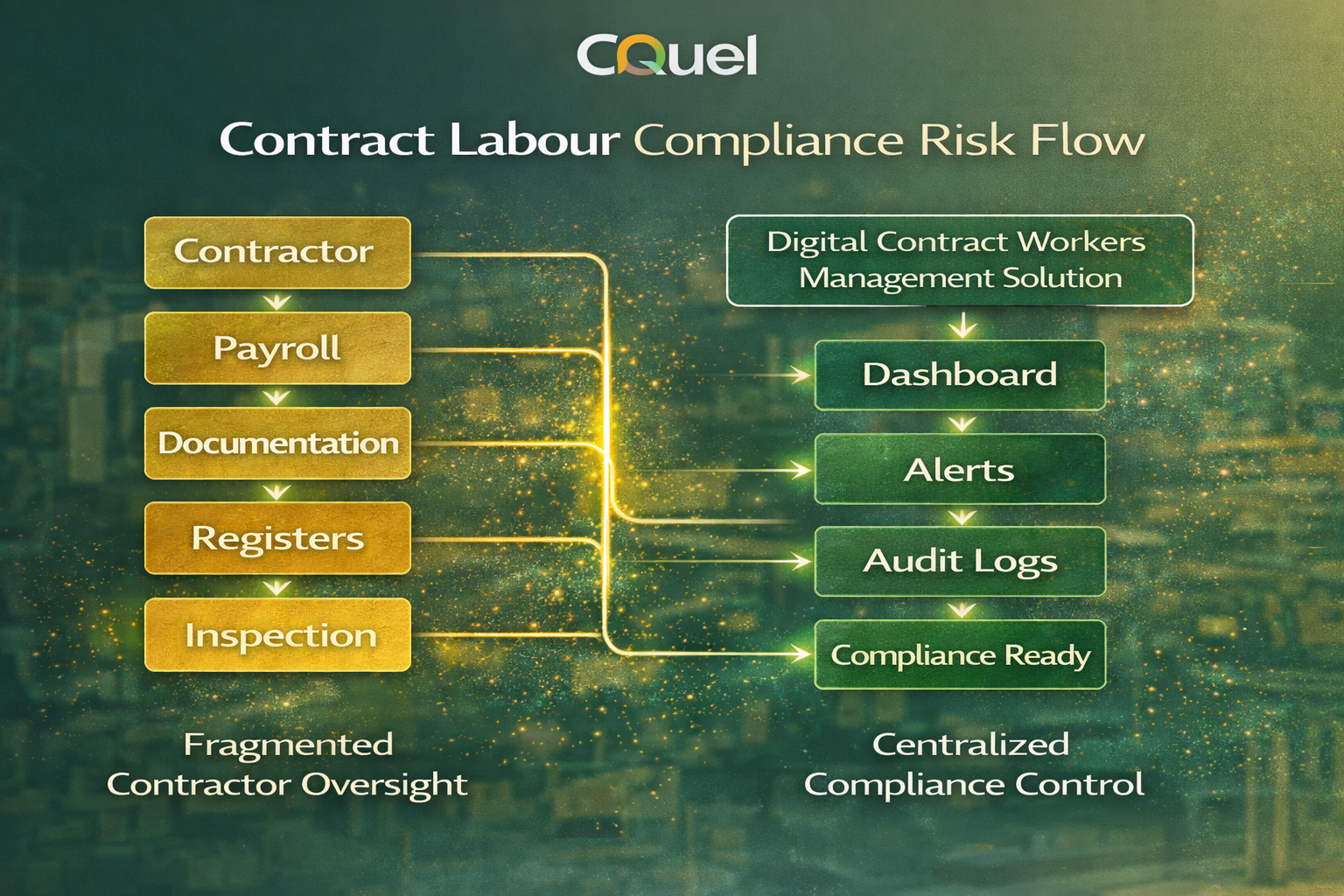
The Architecture of Contract Workers Management Solutions
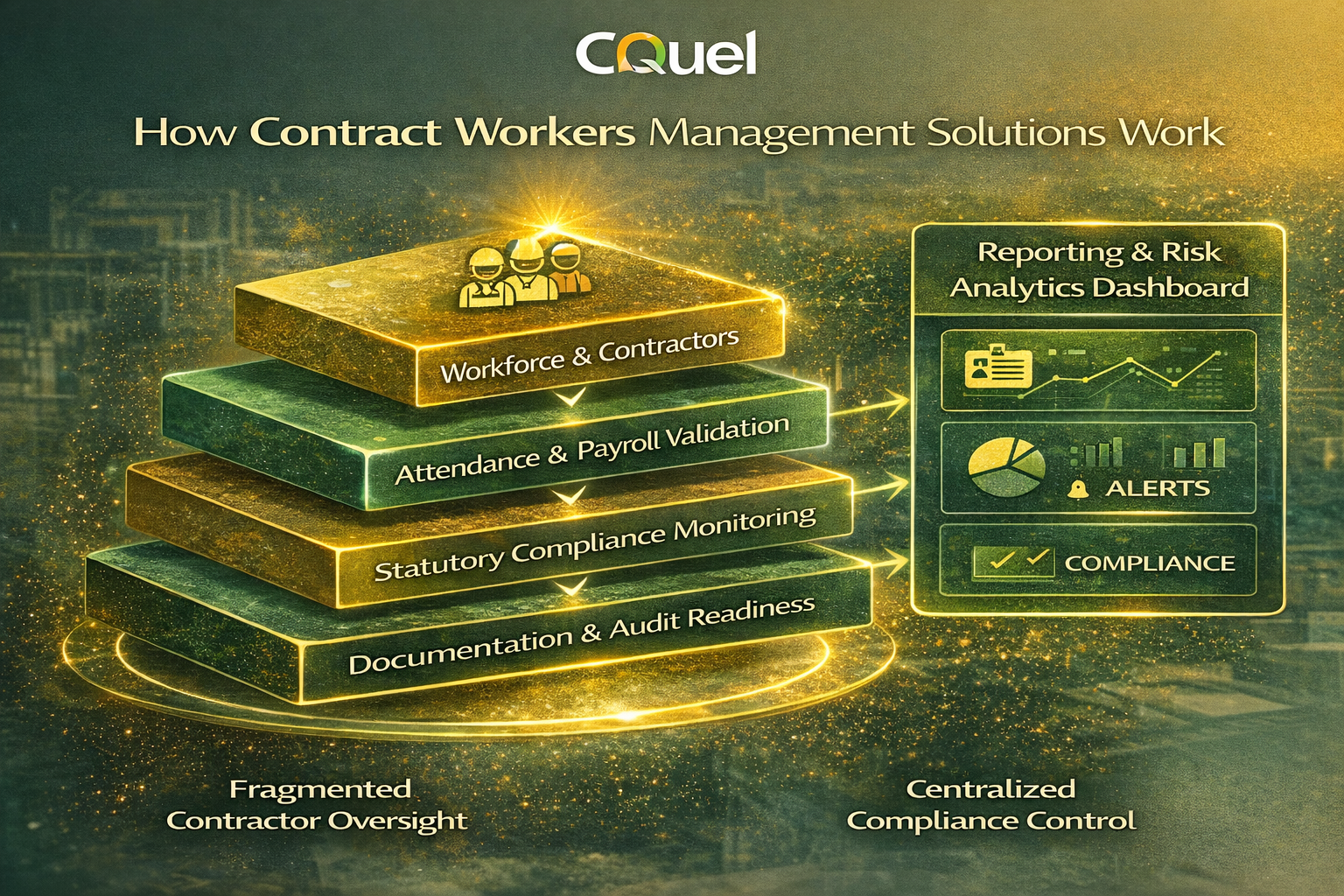
A structured contract labour management solution typically operates across five compliance layers.
1. Contractor Registration & Validation Layer
Before compliance begins, verification must be airtight.
A robust contract labour compliance solutions India validates:
- Contractor licenses under the Indian Contract Labour Regulations
• Registration certificates under the Contract Labour (Regulation & Abolition) Act
• PF and ESIC registration numbers
• PAN & GST verification
• Agreement terms and scope of work
Why does this matter?
Because principal employers remain responsible under law even if payroll is processed by contractors.
As the International Labour Organization (ILO) highlights in its governance guidance:
“Clear accountability frameworks between principal employers and contractors are essential to prevent compliance gaps in outsourced labour.”
– International Labour Organization
Digital contract workforce legal compliance India tools enforce this accountability structurally not verbally.
2. Attendance, Wage & Payroll Verification Layer
This is where compliance risks are highest.
Contract worker payroll compliance in India usually arises from:
- Underpayment of minimum wages
• Incorrect overtime calculation
• Delayed wage disbursement
• Improper statutory deductions
• Mismatch between attendance and payroll
Modern contractor payroll solutions integrate:
- Biometric or digital attendance capture
• Wage sheet validation against notified minimum wages
• Overtime compliance checks
• Automatic wage threshold alerts
• Audit trail preservation
The World Bank’s employment compliance review has emphasised:
“Digitally validated wage systems significantly reduce dispute risk in multi-layer employment structures.”
– World Bank Employment Governance Insights
This is why digital solutions for contract worker management are increasingly essential in India.
3. Statutory Compliance & Contribution Monitoring
Under the statutory compliance contract labour 2025 norms, employers must validate:
- PF contributions (timely deposit & UAN mapping)
• ESIC remittance accuracy
• Bonus eligibility compliance
• Leave & welfare benefit adherence
• Labour welfare fund contributions
Automated contract worker compliance tools generate:
- Real-time statutory dashboards
• Missed-deposit alerts
• Contribution variance reports
• Compliance score indicators
Instead of discovering gaps during inspection, you detect them in advance. That is proactive compliance audit India readiness.
4. Documentation & Audit Readiness Layer
A contract workers audit checklist India should never be assembled at the last minute.
A structured system maintains:
- Digital registers
• Contractor compliance certificates
• Wage payment proofs
• PF & ESIC challans
• Agreement copies
• Licence renewals
• Muster rolls
• Inspection response logs
This ensures:
- Independent labour compliance audit India readiness
• Workplace compliance audit preparedness
• Faster inspection handling
• Lower penalty exposure
Documentation is no longer reactive. It becomes continuously audit-ready compliance in India.
5. Reporting, KPIs & Risk Analytics
Modern contract labour dashboard & reporting tools go beyond record keeping.
They provide:
- Contractor compliance scorecards
• Wage variance alerts
• Labour audit performance benchmark India indicators
• Risk heat maps
• Compliance trend analytics
• Productivity tracking signals
This enables leadership to monitor:
- Contract labour productivity tracking tools performance
• Contract workforce optimization India potential
• Contractor reliability scoring
• Non-compliance risk forecasting
Compliance becomes measurable, not anecdotal.
What Are Key Features of Contract Worker Management Systems?
If you are evaluating contract workforce compliance software in India, look for:
- Automated statutory compliance monitoring
• Real-time contract worker reporting & analytics India
• Mobile contract worker management apps India integration
• Contractor payroll validation engines
• AI-enabled contract worker compliance tools
• Alert systems for contract labour rules 2025 updates
• Compliance audit reporting templates India
• Digital document vault
• Multi-location workforce tracking
Without automation, compliance becomes dependent on people. With automation, compliance becomes systemic.
Is Software Necessary for Contract Labour Compliance?
Short answer: Increasingly, yes.
Manual processes struggle with:
- High contractor volumes
• Multi-location operations
• Changing contract labour rules 2025
• State-level variations
• Inspection unpredictability
Technology does not replace compliance teams. It strengthens them.
It reduces:
- Human oversight gaps
• Payroll reconciliation errors
• Inspection anxiety
• Documentation scrambling
And most importantly, it reduces legal exposure.
How Often Should Contract Worker Compliance Be Reviewed?
Best practice in 2026:
- Monthly payroll validation
• Quarterly statutory review
• Bi-annual compliance audit
• Annual independent labour compliance audit in India
Continuous monitoring beats periodic panic.
Why This Matters in 2026
Indian contract labour regulations are becoming:
- More digitised
• More inspection-driven
• More documentation-focused
• More accountability-centric
Contract workers management solutions 2026 are no longer operational upgrades.
They are a risk mitigation infrastructure.
Without structure, compliance is accidental.
With structured systems, compliance becomes predictable.
Contract Labour Rules 2025 & Their Impact on Contract Worker Management
If you manage contract workers in India today, 2025 is not “business as usual.”
The regulatory environment has shifted.
Not dramatically in headline form but significantly in enforcement posture.
The impact of Contract Labour (Regulation & Abolition) Rules 2025 is not about new paperwork.
It’s about stronger accountability.
Principal employers are being held more directly responsible for:
- Wage compliance
• Statutory deposit verification
• Contractor licensing validity
• Workplace safety conditions
• Audit documentation availability
In short, compliance is no longer “outsourced” just because payroll is.
And this changes how contract worker management in India must function in 2026.
Increased Principal Employer Liability
Under Indian contract labour regulations, the principal employer has always carried ultimate responsibility.
But enforcement intensity is increasing.
What this means in practice:
- If a contractor underpays minimum wages liability flows upward
• If PF or ESIC deposits are delayed, exposure includes the principal employer
• If records are incomplete during inspection, the establishment is questioned first
This shifts the compliance mindset from:
“Contractor handles it.”
To:
“We must validate it.”
The International Labour Organisation (ILO), in its governance advisory on subcontracted labour, emphasises:
“Where labour is contracted, responsibility does not disappear it transfers upward to those controlling the work environment.”
– International Labour Organisation (ILO)
That principle is increasingly visible in inspection practice across India.
Which is why contract labour compliance solutions in India must now include real-time validation, not post-facto documentation.
Digital Inspection & Documentation Expectations
Another shift under contract labour rules 2025 is digitization.
Labour departments are increasingly:
- Requesting electronic records
• Validating PF/ESIC online
• Cross-verifying attendance and payroll
• Reviewing contractor licence databases
• Checking wage transfers digitally
Manual registers are no longer sufficient alone.
Factories and establishments must maintain:
- Digital wage sheets
• Electronic attendance logs
• Compliance dashboards
• Audit trail history
This is where contract workforce compliance software India becomes essential.
Not because the law says “use software.” But because enforcement now assumes data visibility.
Wage & Overtime Risk Zones
Contract labour payroll India remains one of the highest violation categories.
Common audit findings include:
- Minimum wage mismatch across skill categories
• Overtime calculation errors
• Payment delays beyond statutory timelines
• Wage slip non-issuance
• Incorrect contractor billing alignment
These gaps often arise from:
- Poor coordination between HR and the contractor
• Manual spreadsheet reconciliation
• Lack of standardised payroll validation process
Modern contractor payroll solutions reduce these risk areas by:
- Auto-validating wages against notified minimum wage rates
• Flagging overtime beyond statutory limits
• Mapping attendance-to-wage alignment
• Generating statutory compliance reports
Without structured systems, wage risk accumulates silently. With automated compliance tools, discrepancies surface early.
Contract Worker Safety & Workplace Obligations
Under the statutory compliance contract labour 2025 norms, establishments must ensure:
- Safe working conditions
• Welfare amenities (where applicable)
• Health and hygiene compliance
• Working hour adherence
If safety incidents occur involving contract workers:
Liability investigation extends to the principal employer.
This is why contract labour management services must integrate:
- Contractor onboarding verification
• Safety training tracking
• Incident documentation logs
• Risk reporting dashboards
Compliance is no longer isolated to payroll. It now includes operational safety integration.
Risk of Non-Compliance in 2026
The risks of non-compliance with contract labour laws include:
- Monetary penalties
• Licence suspension
• Contract termination disputes
• Prosecution in severe violations
• Reputational damage
• Work stoppage risk
The World Bank’s regulatory risk assessment studies have consistently found:
“Organizations with decentralized contractor oversight show significantly higher compliance dispute exposure.”
– World Bank Governance & Regulatory Risk Report
This is why independent labour compliance audit India is becoming a preventive tool, not a corrective one.
What This Means for Your Organisation
If you are operating in:
- Manufacturing
• Construction
• Infrastructure
• IT & IT-enabled services
• Logistics
• Industrial parks
You must shift from:
Periodic contractor document collection to the continuous contract labour workforce optimization India with compliance visibility. Because 2026 enforcement is data-driven.
And data-driven enforcement exposes invisible weaknesses.
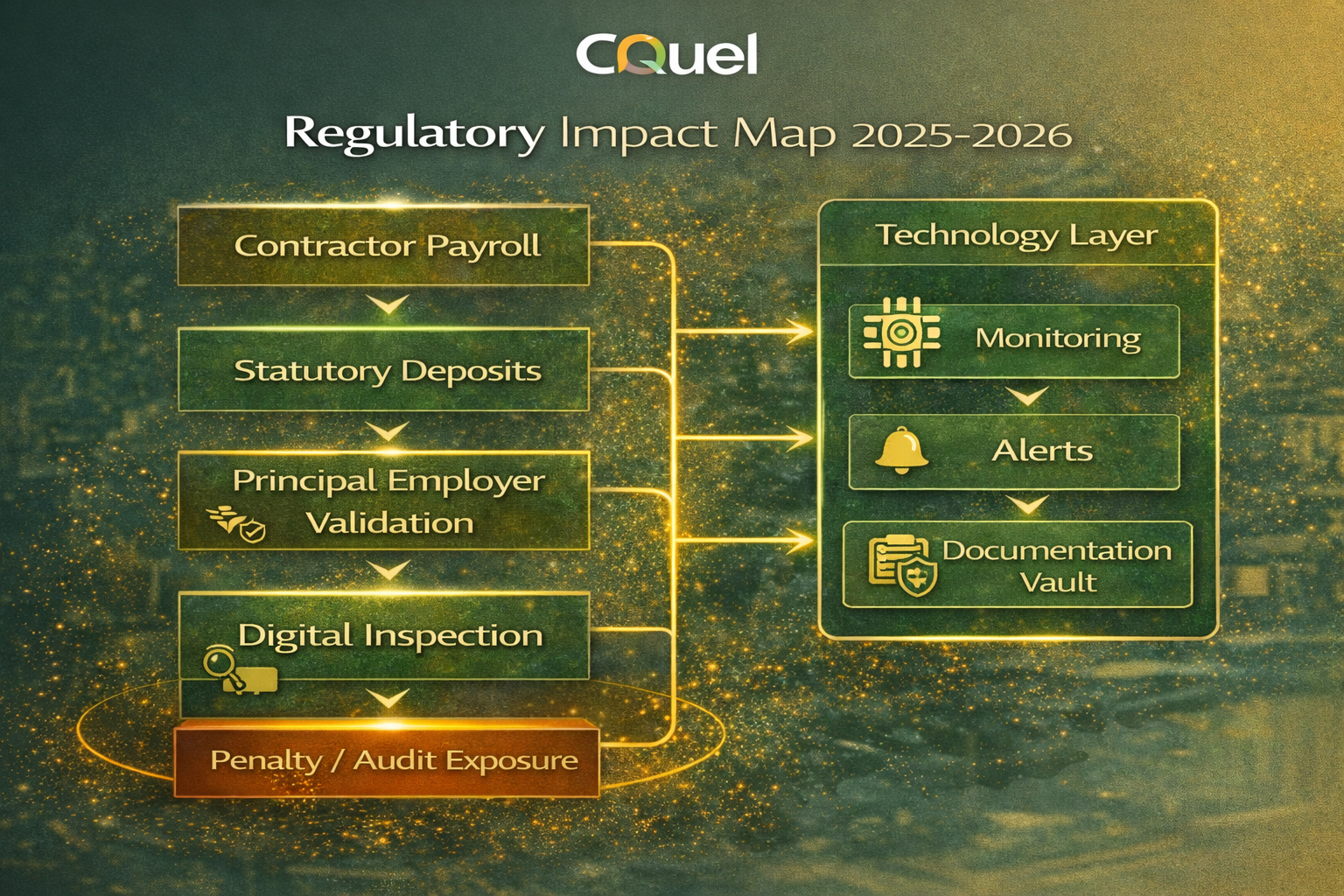
The Strategic Shift
Old Model: Collect documents quarterly → Hope they are correct → React during inspection.
2026 Model: Automated contract worker compliance tools → Real-time dashboards → Early risk alerts → Audit-ready compliance in India.
That shift defines modern contract labour management solutions.
How CQUEL Helps Factories Stay Audit-Ready in 2026
Most factories don’t need more paperwork.
They need clarity.
Clarity on:
- Where compliance risk actually exists
• Which contractors are high exposure
• Whether payroll structures align with labour law
• How to prepare before an inspection notice arrives
• How to move from reactive compliance to proactive governance
That’s where CQUEL steps in.
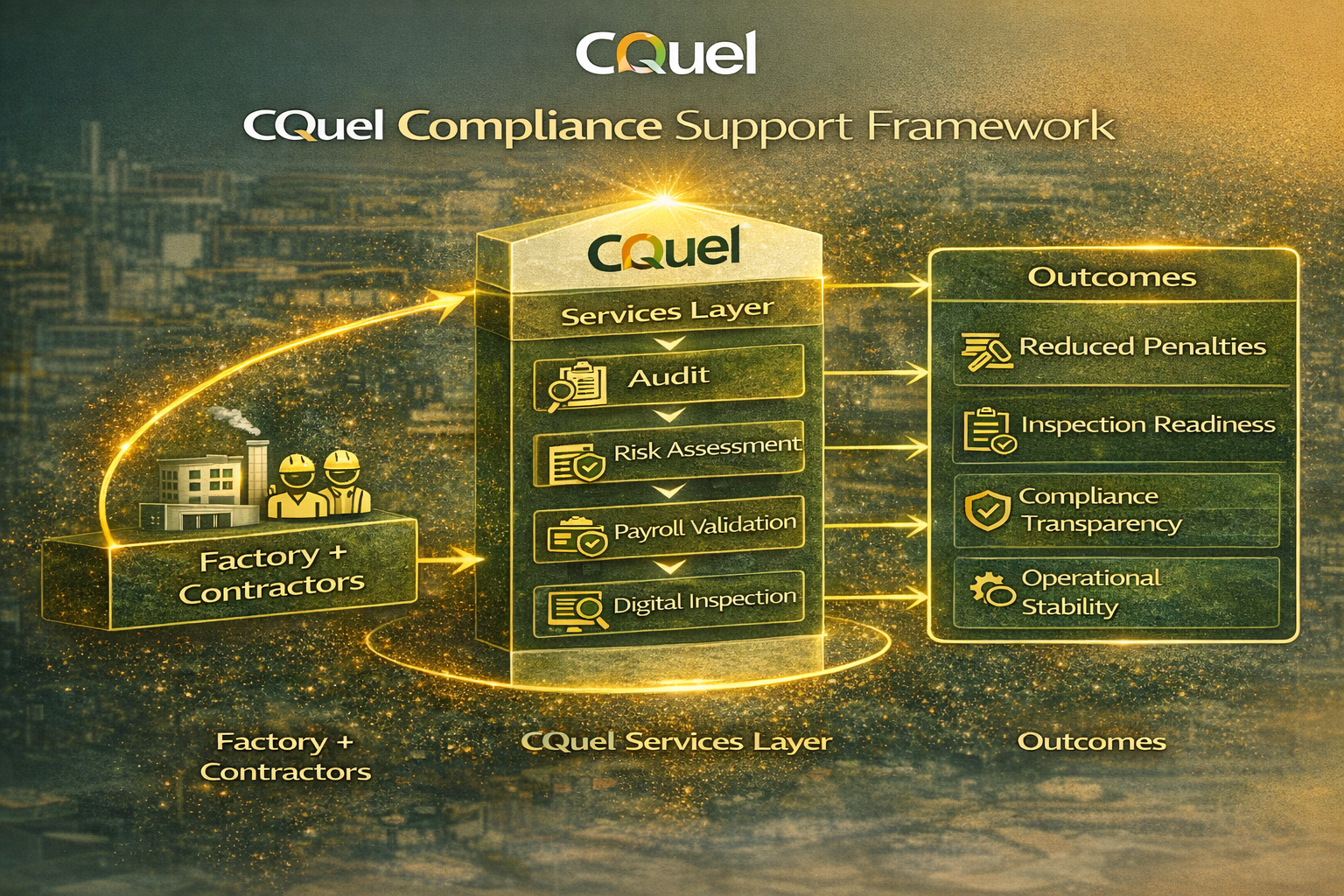
CQUEL is not just a labour compliance consultant. It functions as a structured compliance partner for factories managing contract labour at scale.
End-to-End Labour Compliance Audit Services India
CQUEL conducts structured:
- Factory compliance audit India
• Labour law compliance audit
• Statutory compliance audit India
• Independent labour compliance audit in India
• Compliance risk assessment India
Each audit covers:
- Contractor licence validation
• Wage & statutory deposit verification
• PF & ESIC reconciliation
• Minimum wage classification review
• Overtime compliance
• Safety & welfare obligations
• Documentation and register validation
But more importantly:
Every audit includes a risk-scored compliance exposure matrix.
You don’t just get a report.
You get a clear action roadmap.
Proactive Compliance, Not Just Inspection Preparation
Many organisations call consultants after receiving:
- Inspection notices
• Show-cause letters
• PF or ESIC discrepancies
• Contractor violations
CQUEL works differently.
The focus is:
- Proactive compliance audit India
• Audit-ready compliance India
• Preventive labour risk governance
• Digital compliance tracking
This reduces:
- Penalty exposure
• Legal disputes
• Contractor mismanagement
• Operational disruption
Compliance becomes predictable, not panic-driven.
Contract Labour Governance & Risk Benchmarking
CQUEL helps factories build:
- Contract workers audit checklist India
• Labour compliance risk assessment India frameworks
• Contractor performance benchmarks
• Compliance dashboard reporting
• Compliance audit reporting templates India
Instead of reviewing compliance once a year, factories gain:
- Monthly visibility
• Contractor risk scoring
• Statutory deposit tracking
• Renewal alerts
• Documentation readiness index
This is how mature factories manage compliance in 2026.
Payroll & Statutory Structuring Advisory
Contract labour compliance often fails at payroll.
CQUEL supports:
- Contract worker payroll compliance in India
• Wage restructuring under labour laws
• PF & ESIC compliance validation
• Contractor payroll audit
• Salary structuring alignment
If minimum wage classification, overtime calculations, or statutory deductions are misaligned, CQUEL identifies and corrects them before they become enforcement issues.
Labour Compliance Training Services India
Compliance improves when teams understand the law.
CQUEL conducts:
- HR compliance workshops
• Contractor compliance training
• Labour inspection preparedness sessions
• Factory compliance best practices training
Because even the best compliance software fails if teams don’t understand obligations.
Technology-Enabled Compliance Support
Modern compliance requires visibility.
CQUEL supports integration of:
- Digital tools for compliance audit India
• Contract labour dashboard & reporting tools
• Automated contract worker compliance tracking
• Audit trail documentation systems
• Compliance alert systems
This bridges the gap between compliance theory and operational execution.
Why Factories Choose CQUEL
Factories working with CQUEL typically achieve:
- Reduced audit findings
• Lower statutory exposure
• Clear contractor accountability
• Faster inspection resolution
• Improved compliance documentation discipline
But most importantly:
They stop reacting to labour audits. They start managing compliance systematically.
If You Are Managing Contract Labour in 2026
Ask yourself:
- Do you know your contractor risk exposure today?
• Are PF & ESIC deposits fully verified?
• Is your documentation inspection-ready?
• Are wage structures legally defensible?
• Would you pass an independent compliance audit this quarter?
If the answer isn’t 100% confident, it’s time to strengthen your compliance framework.
CQUEL helps factories move from uncertainty to audit-ready confidence.
Frequently Asked Questions (FAQ)
1. How do contract labour management solutions work?
Contract labour management solutions work by centralising compliance, payroll, documentation, and reporting for all contract workers in one structured system.
These solutions typically:
- Register contractors and validate licences
• Track statutory compliance (PF, ESIC, minimum wages)
• Monitor attendance and wage payments
• Generate compliance alerts
• Maintain digital documentation for audits
• Provide dashboards and reporting tools
In 2026, most modern systems include automated contract worker compliance tools and real-time contractor risk monitoring.
Instead of managing compliance manually through spreadsheets, organizations use contract workforce compliance software India to:
- Reduce audit exposure
• Improve documentation readiness
• Ensure contractor accountability
The goal is not just administration it is workforce management compliance with full visibility.
2. How to manage contract workers under Indian labour laws?
To manage contract workers under Indian labour laws, employers must comply with:
- Contract Labour (Regulation & Abolition) Act
• Contract Labour Rules 2025
• Code on Wages
• Social Security Code
• OSH compliance standards
Key steps include:
- Verify contractor licence and registration
- Ensure statutory compliance contract labour 2025
- Validate wage payments and minimum wage adherence
- Confirm PF & ESIC contributions
- Maintain required registers and documents
- Conduct periodic contract workers audit checklist in India reviews
Effective management requires structured contract labour compliance solutions in India, not just periodic checks.
3. Is software necessary for contract labour compliance?
While not legally mandatory, contract workforce compliance software in India is strongly recommended in 2026 for organisations managing multiple contractors.
Manual compliance tracking often leads to:
- Missing PF/ESIC discrepancies
• Licence renewal lapses
• Incomplete wage validation
• Documentation gaps during inspections
Digital solutions for contract worker management provide:
- Automated alerts
• Centralised documentation
• Payroll validation tools
• Compliance dashboards
For factories and enterprises, AI-enabled contract worker compliance tools significantly reduce the risk of non-compliance.
4. What are the risks of non-compliance with contract labour laws?
Risks of non-compliance include:
- Monetary penalties
• Prosecution under labour law contract workers provisions
• Contractor licence suspension
• Principal employer liability
• Operational disruption
• Reputational damage
Under statutory compliance contract labour 2025, principal employers can be held responsible if contractors fail to comply with:
- Wage payment laws
• PF & ESIC deposits
• Safety provisions
This is why independent labour compliance audits and proactive compliance audit India strategies are critical.
5. What documents are required for contract labour compliance audits?
During a contract labour compliance audit, authorities typically request:
- Contractor registration certificate
• Contractor licence
• Agreement between principal employer & contractor
• Wage registers
• Attendance records
• PF & ESIC challans
• Bank transfer proofs
• Muster rolls
• Overtime records
• Safety and welfare documentation
A structured contract workers audit checklist in India ensures these documents are updated and inspection-ready.
6. How often should contract worker compliance be reviewed?
Best practice is:
- Monthly internal compliance review
• Quarterly statutory compliance audit
• Annual independent labour compliance audit in India
High-risk sectors (manufacturing, infrastructure, logistics) may require more frequent reviews.
Proactive compliance audit strategies in India reduce last-minute correction pressure and prevent enforcement action.
7. What contract worker KPIs should be monitored?
Key contract labour performance and compliance KPIs include:
- % PF compliance accuracy
• ESIC deposit validation rate
• Contractor licence renewal status
• Wage compliance ratio
• Overtime compliance index
• Documentation readiness score
• Contract labour productivity tracking tools output metrics
• Audit observation count
Monitoring contract labour dashboard & reporting tools allow for the early detection of compliance gaps.
8. How can technology improve contract worker management?
Technology improves contract worker management by:
- Automating statutory compliance tracking
• Reducing manual errors
• Enabling mobile contract worker management apps India
• Providing contractor payroll solutions
• Generating compliance audit reporting templates India
• Offering AI-enabled compliance alerts
Technology transforms compliance from reactive to predictive.
In 2026, factories using automated contract worker compliance tools experience:
- Faster audit response
• Reduced statutory exposure
• Improved workforce optimization
• Better contractor governance
9. How do new 2025 rules affect contract workers’ wages?
The Contract Labour Rules 2025 and labour law contract workers updates impact:
- Minimum wage alignment
• Wage component structuring
• Overtime calculations
• PF contribution base adjustments
• ESIC eligibility thresholds
Organisations must review:
- Contract labour payroll India
• Contractor billing alignment
• Wage compliance under Code on Wages
Non-alignment increases the risk of backdated liabilities and penalties.
10. How to fix non-compliance found in a factory audit?
If non-compliance is found:
- Identify root cause (documentation vs payroll vs contractor failure)
- Rectify wage discrepancies immediately
- Clear statutory dues with penalties if applicable
- Update compliance processes
- Conduct a follow-up internal compliance audit
- Provide contract labour compliance training in India
Working with a labour compliance consultant ensures structured correction rather than temporary fixes.
Book a Contract Labour Compliance Strategy Call
Let’s review:
- Your current contract labour management structure
• Compliance risk exposure
• Payroll validation systems
• Contractor monitoring process
• Technology gaps
In 30 minutes, you’ll gain clarity on:
Where your compliance risks exist
What can be automated
What needs immediate correction
How to build long-term compliance resilience
Schedule a Contract Worker Compliance Consultation with Cquel
Because in 2026, contract worker compliance isn’t optional.
It’s operational stability.