

If your organisation engages apprentices, whether as an MSME, corporate, training partner, or institution, 2026 is not a minor update. It is a structural compliance shift.
If we already follow the Apprenticeship Act, do we really need to change anything now?
That’s exactly where many HR and compliance teams pause.
You may already:
But the Apprenticeship Rules 2026 India update changes how quota, stipend, digital contracts, and reservation compliance are structured and audited.
This isn’t just administrative refinement.
It strengthens digital oversight and formalises workforce planning accountability.
The Government of India has consistently aligned apprenticeship reforms with the national skill development agenda. The 2026 update builds on earlier amendments by:
The intent is clear:
Move apprenticeships from informal training exposure to a regulated, digitally tracked workforce development system.
Under the updated regulatory framework, employers must treat apprenticeship engagement as a formal compliance function, not just an HR initiative.
The impact spans across sectors and organisation sizes.
HR Managers
Payroll Teams
MSMEs
Large Corporates
Educational Institutions & Training Partners
Whether you employ 50 people or 5,000, the apprentice quota and reporting rules apply based on workforce size thresholds.
The 2026 amendment signals something deeper.
Apprenticeships are no longer viewed only as skill-building pathways.
They are now embedded within India’s structured workforce planning model.
Under the evolving skill development framework, India 2026, apprenticeship compliance connects to:
For employers, this means: Apprenticeship is no longer optional optics. It is measurable workforce participation.
In the sections ahead, we will break down:
The goal is simple:
To help you understand what changed, what applies to your organisation, and how to stay compliant without confusion.
The Apprenticeship Rules 2026 India introduce structural updates that affect how employers recruit, register, compensate, and report apprentices.
This is not a cosmetic amendment.
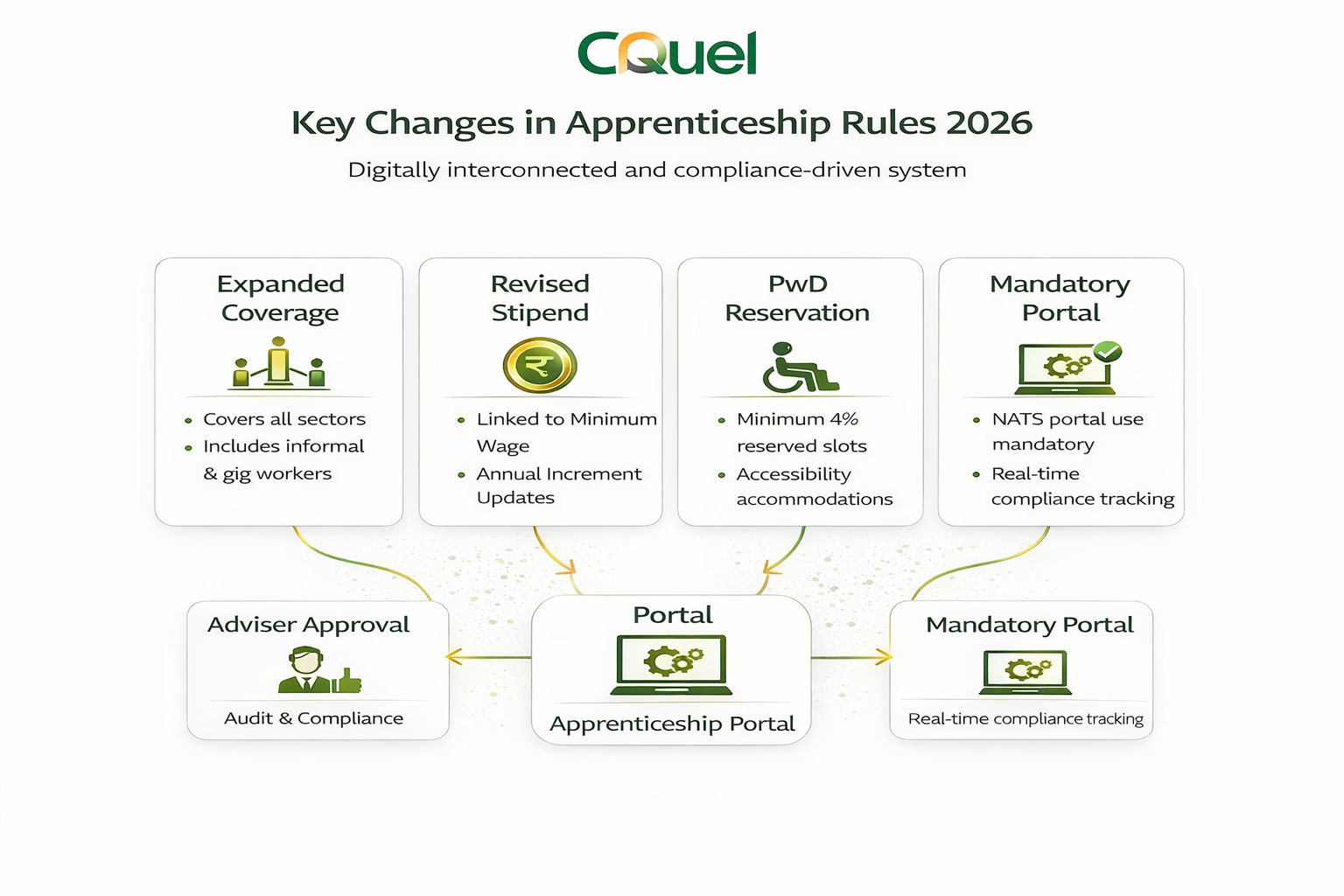
The Apprenticeship (Amendment) Rules 2026 clarify employer accountability in four major areas:
If you manage apprenticeship compliance in 2026, these are the changes you must understand clearly.
One of the most significant updates under the Apprenticeship Law Update 2026 India is the strengthening of degree apprenticeship programs 2026.
Earlier frameworks focused heavily on trade apprenticeships. The 2026 amendment reinforces structured pathways for:
Under the updated framework:
This expansion supports India’s larger workforce development objectives.
For employers, this means:
Apprenticeships are no longer limited to shop-floor training.
They can be strategically aligned with skilled and semi-skilled workforce pipelines.
Another core change involves the apprenticeship stipend rates for 2026.
The revised apprentice stipend structure India 2026 updates minimum stipend slabs across categories, including:
Employers must now:
The update also strengthens monitoring mechanisms.
Non-payment or underpayment of stipend can now trigger compliance scrutiny under digital reporting mechanisms.
For HR and payroll teams, this translates to:
We will break down calculation examples in Section 3.
The PwD apprenticeship reservation 2026 provision formalises inclusive participation within the apprenticeship ecosystem.
Under the revised apprenticeship reservation policy, India 2026, employers must ensure:
This update reinforces accessibility and workforce inclusion within India’s skill development strategy.
For employers, this requires:
Reservation compliance is no longer implied; it must be demonstrable.
Digital governance is central to the Apprenticeship Rules 2026 India.
The apprenticeship portal registration process 2026 is now mandatory for:
The shift toward online compliance ensures:
Employers must ensure:
Failure to register or update records through the portal can expose organisations to compliance risk.
This digital-first shift strengthens audit-readiness under apprenticeship compliance audit India 2026 frameworks.
When viewed together, the 2026 changes signal a clear transition:
From apprenticeship as informal workforce exposure
To apprenticeship as a regulated, digitally tracked compliance system.
For employers, the key implications are:
The next section will help you understand how these changes differ from the 2019 framework and what that means operationally.
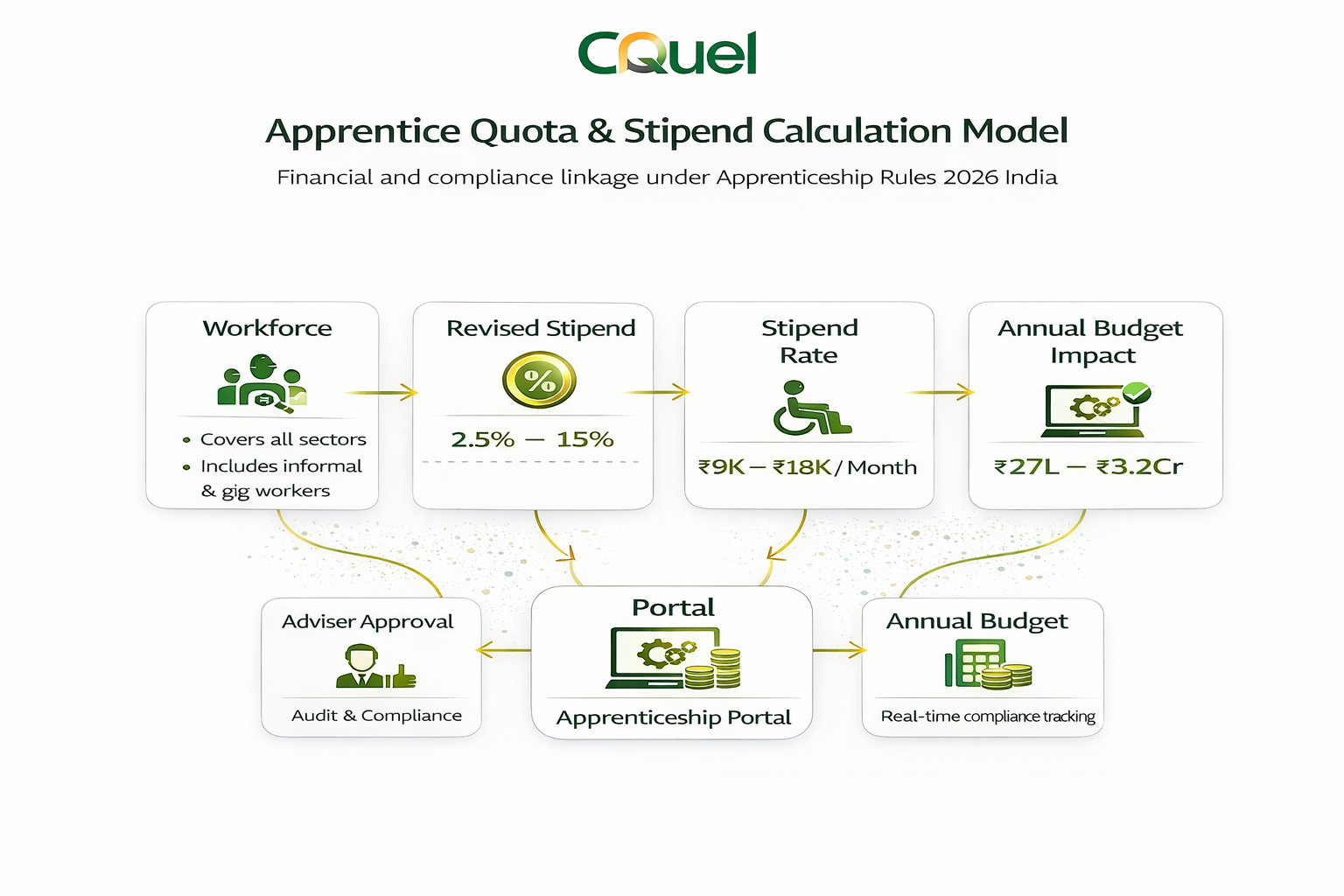
If you are responsible for HR compliance or payroll budgeting, this is the section that directly affects your numbers.
Under the Apprenticeship Rules 2026 India, employers must accurately calculate:
Errors in quota calculation or stipend payment can trigger scrutiny during an apprenticeship compliance audit India 2026 review.
Let’s break this down clearly and practically.
Under the updated framework, employers must engage apprentices as a percentage of their total workforce strength.
The apprentice quota calculation for India 2026 follows the prescribed percentage band under the Apprentices Act and updated rules.
Step 1: Identify Total Workforce Strength
Include:
(Exclude apprentices already counted.)
Example:
Total workforce = 420 employees
Step 2: Apply the Prescribed Percentage Range
If the rule prescribes engagement between X%–Y% of the workforce:
Minimum apprentices = 420 × minimum %
Maximum apprentices = 420 × maximum %
For illustration:
If minimum engagement = 2.5%
420 × 2.5% = 10.5 → Round as per rule guidance
If maximum engagement = 15%
420 × 15% = 63
This gives the permissible engagement band.
Step 3: Check Trade / Category Distribution
Under the Apprenticeship (Amendment) Rules 2026, the quota may also depend on:
Step 4: Validate Through Portal Registration
All calculations must reflect:
If the declared apprentice count does not align with workforce data, compliance flags may arise.
Under the updated digital compliance ecosystem:
This reinforces the importance of maintaining documentation for:
As noted in the regulatory guidance framework:
“Apprenticeship engagement must be demonstrable, transparent, and aligned with notified workforce parameters.”
– Ministry of Skill Development & Entrepreneurship (Regulatory Clarification Note)
This reflects a clear shift toward measurable compliance.
The second critical area under the Apprenticeship Rules 2026 India is stipend compliance.
Updated apprenticeship stipend rates for 2026 require employers to reassess budgeting models.
Assume:
Monthly stipend cost = 20 × ₹X
Annual stipend cost = Monthly cost × 12
Now add:
This becomes your apprenticeship payroll budgeting 2026 base estimate.
Under apprenticeship payroll compliance India 2026, employers must:
Failure to comply can trigger an audit review.
The regulatory note underlines:
“Stipend payment must reflect minimum prescribed standards and be supported by documented proof.”
– Directorate General of Training (DGT) Compliance Circular
This reinforces payroll discipline.
Many organisations underestimate:
Small miscalculations multiply over time.
That’s why structured calculation templates and compliance tracking systems are becoming essential under the evolving apprenticeship ecosystem, India 2026.
Under Apprenticeship Rules 2026:
Quota calculation is not optional
Stipend compliance is not flexible
Digital reporting is not manual
Everything is interconnected.
If you do not:
You risk non-alignment during compliance checks.
The next section will break down reporting, tripartite agreements, and adviser approval requirements in detail.
Under the Apprenticeship Rules 2026 India, compliance is no longer paperwork-driven it is portal-driven, time-bound, and traceable.
For HR and compliance leaders, this is where most operational risk sits.
The 2026 framework strengthens:
If your apprenticeship engagement is active, your reporting must be active too.
Let’s break down what that means in practice.
Under the updated compliance structure, employers must submit periodic reports through the designated portal.
The apprenticeship compliance reporting format 2026 generally includes:
This reporting is aligned with the digital apprenticeship portal registration process 2026.
Why this matters:
In 2026, compliance is monitored digitally not only during inspection.
If reporting lapses, it may impact:
A tripartite apprenticeship contract 2026 becomes mandatory when:
The tripartite apprenticeship agreement India 2026 includes three parties:
This agreement defines:
It formalises accountability across stakeholders.
Under the updated rules, digital execution of such contracts through the apprenticeship portal is expected in many cases.
Failure to execute required tripartite agreements may invalidate the apprenticeship engagement for compliance purposes.
In specific cases, apprenticeship adviser approval 2026 is required before engagement begins.
Situations where approval may be necessary:
The apprenticeship adviser approval process 2026 typically involves:
Approval ensures the program aligns with regulatory training standards.
Engaging apprentices without required approval may expose employers to compliance scrutiny.
One of the most important shifts under the Apprenticeship (Amendment) Rules 2026 is digitisation.
The apprenticeship contracts online portal registration 2026 requirement means:
Portal-based registration is not procedural it is foundational to compliance.
If the portal data does not match:
It creates a compliance mismatch.
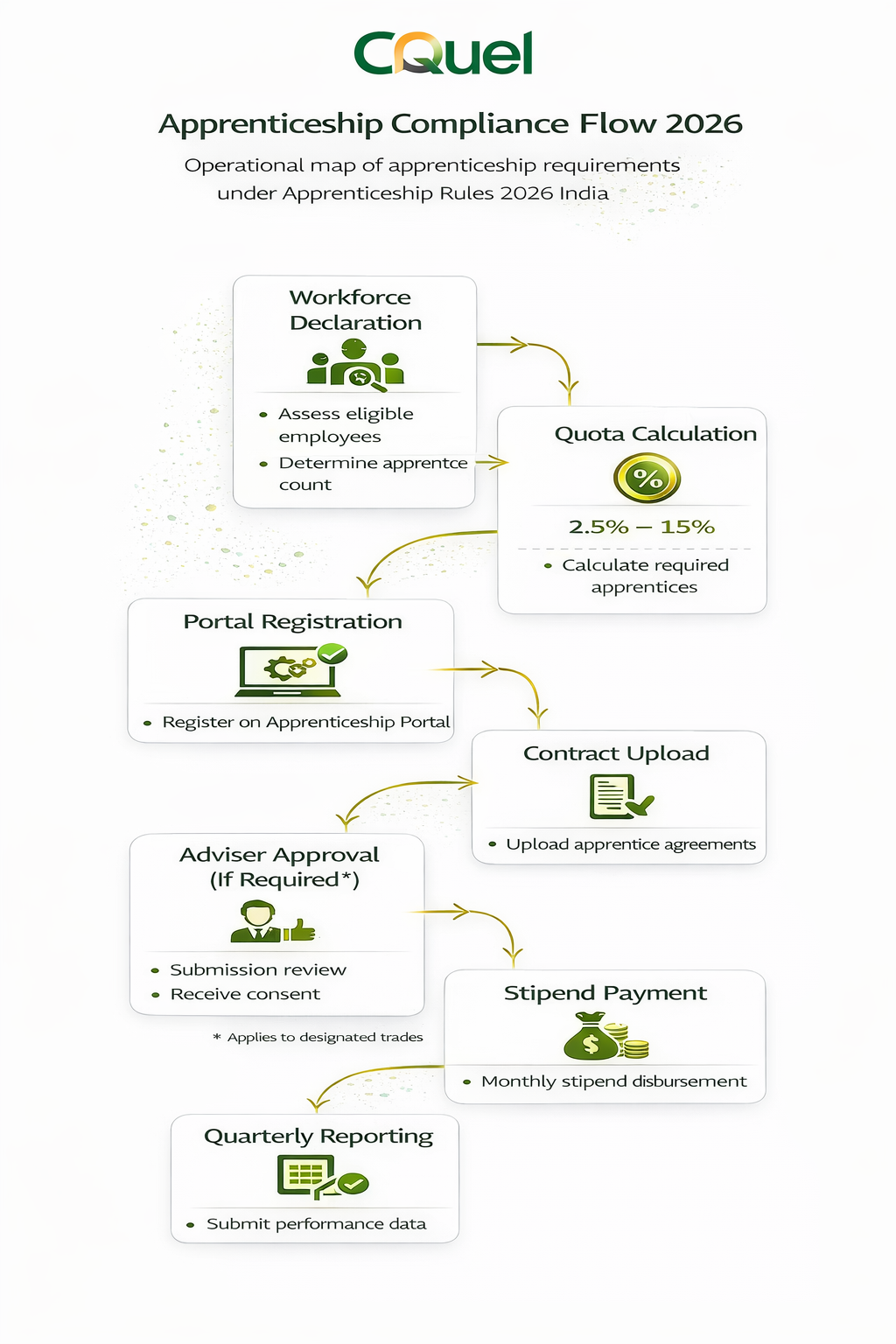
Here is how the compliance cycle typically flows in 2026:
Each step connects to the digital portal ecosystem.
This reflects a larger transformation in the apprenticeship ecosystem in India 2026 from passive engagement to structured compliance governance.
Under Apprenticeship Rules 2026 India:
This is why many employers are moving toward structured apprenticeship compliance audit India 2026 preparation frameworks.
The next section explores institutional and international apprenticeship provisions and how the ecosystem is expanding beyond traditional employer-only engagement.
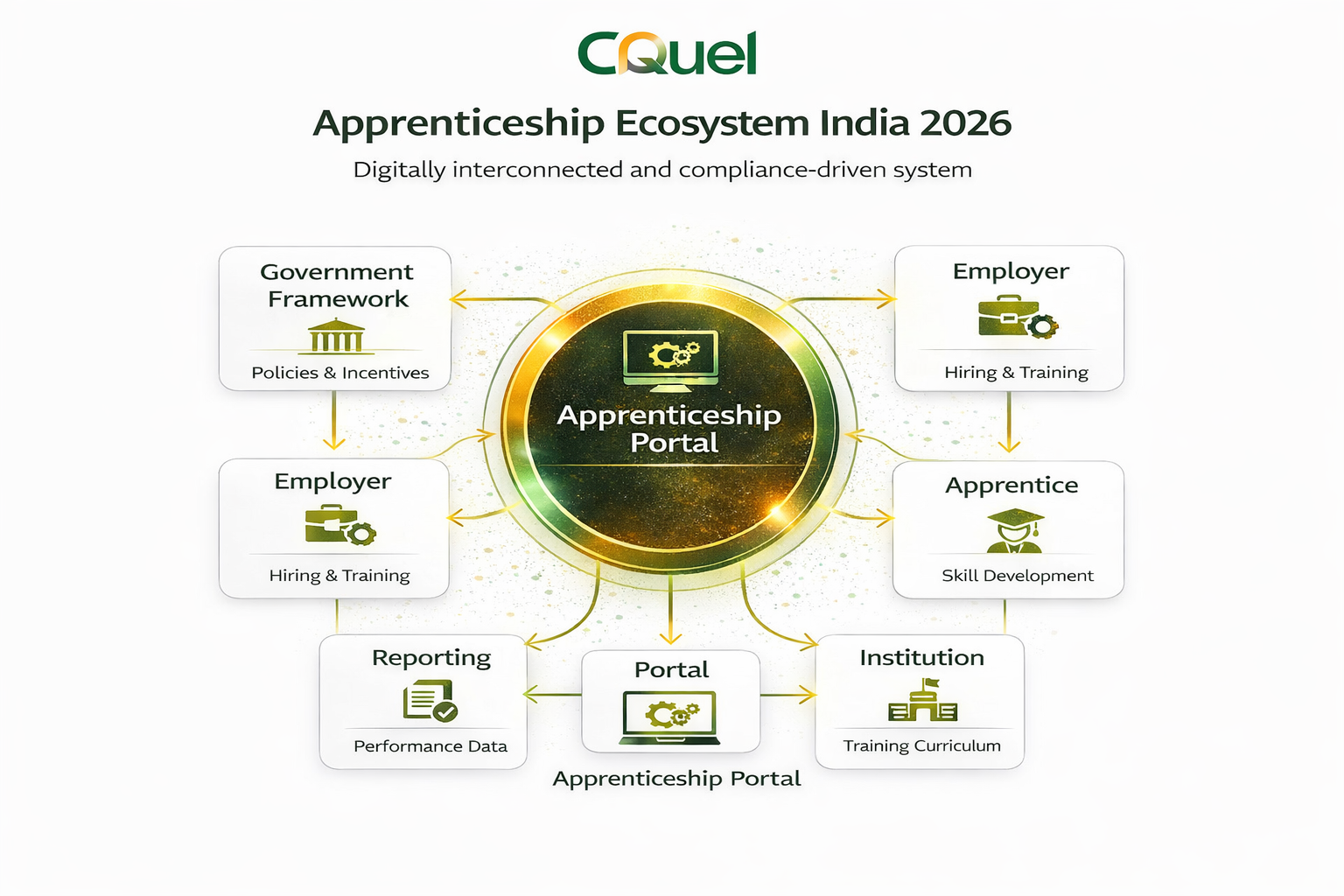
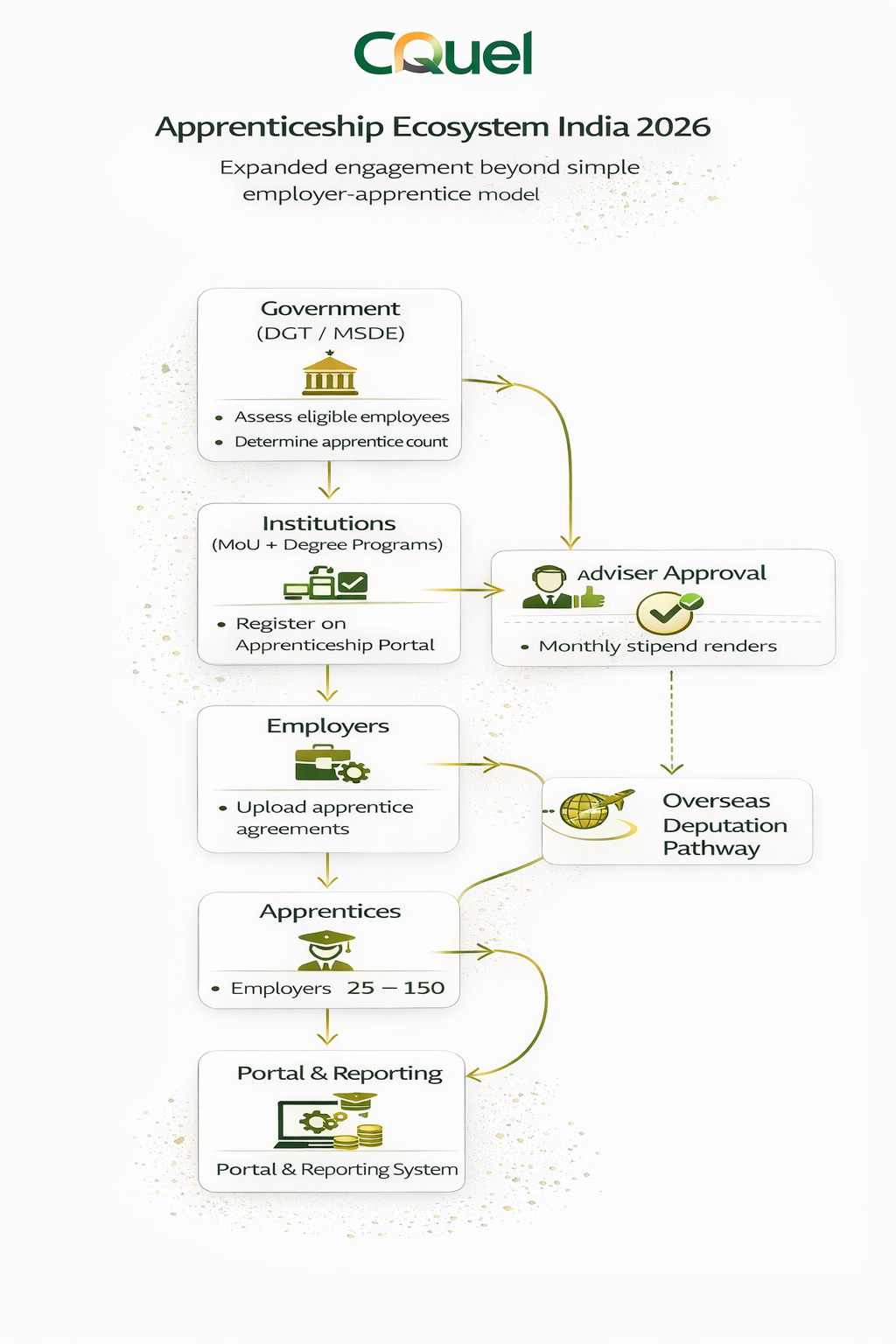
One of the most significant shifts under the Apprenticeship Rules 2026 India is the formal expansion of the apprenticeship ecosystem beyond just employers and apprentices.
The 2026 framework strengthens:
This signals a policy direction: apprenticeship is no longer only a workforce compliance requirement; it is a structured skill development pathway aligned with India’s broader skill development framework, India 2026.
If you are an HR leader, MSME owner, corporate compliance manager, or institutional administrator, this expansion directly affects how you structure programs.
Under the updated framework, educational institutions, including universities, technical institutes, and skill development centres, play a more formal role in apprenticeship engagements.
An apprenticeship MoU with institutions, 2026, typically defines:
This institutional integration is especially relevant for:
From a compliance perspective, employers must ensure:
If institutions are involved but documentation is incomplete, the engagement may not qualify under the formal apprenticeship compliance India 2026 standards.
The updated framework also recognises global skill mobility.
Under the overseas apprenticeship training 2026 provisions, apprentices may be deputed internationally in structured cases, subject to:
The International Apprenticeship Deputation Rules 2026 aim to:
However, overseas deputation is not automatic.
Employers must:
Failure to obtain proper approvals can create both domestic and cross-border compliance risks.
The Apprenticeship (Amendment) Rules 2026 reflect a systemic shift.
Previously, apprenticeships were often treated as:
In 2026, the model emphasises:
This reflects a broader evolution in the apprenticeship ecosystem in India 2026, where apprenticeship is positioned as a structured skill pipeline aligned with national development goals.
For employers, this means:
Apprenticeship is no longer isolated within HR.
It intersects with:
This expansion increases opportunity but also increases documentation responsibility.
If you are reviewing your apprenticeship program in 2026, consider:
These questions form the foundation of an apprenticeship compliance audit India 2026.
The next section provides a structured, audit-ready Apprenticeship Compliance Checklist India 2026 that you can use internally.
Under the Apprenticeship Rules 2026 India, compliance is no longer limited to hiring apprentices and paying stipends.
Documentation, reporting, quota validation, portal registration, PwD reservation, and adviser approvals now form a structured regulatory framework.
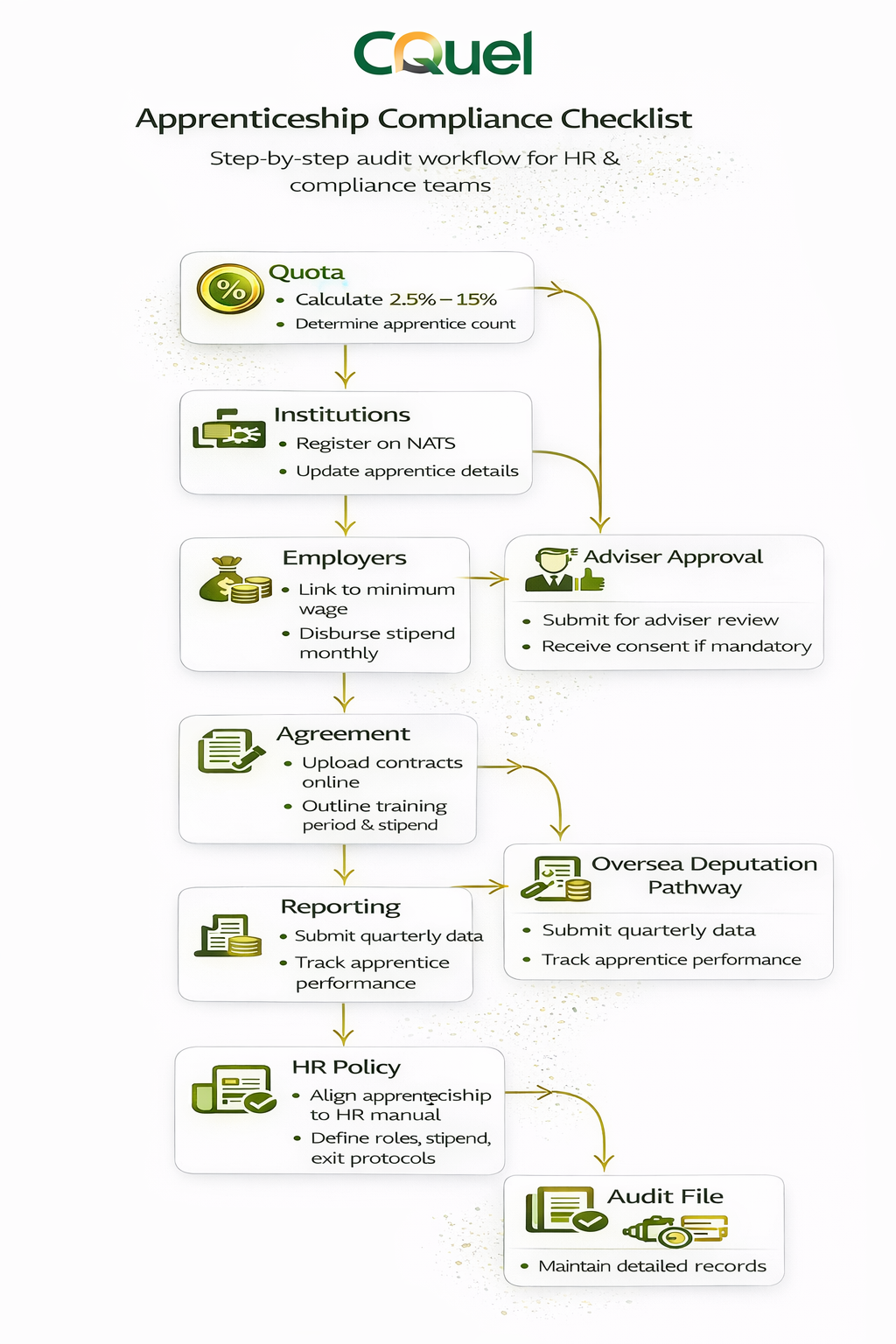
If you want your program to pass an apprenticeship compliance audit in India 2026, this section gives you a practical, audit-ready apprenticeship HR compliance checklist 2026.
This checklist is designed for:
Use this as an internal review tool before inspection or adviser verification.
Confirm that your workforce strength supports your declared apprentice intake.
✔ Calculate total eligible workforce (exclude trainees, contractors where applicable)
✔ Apply the apprenticeship quota calculation formula 2026
✔ Validate minimum and maximum percentage compliance
✔ Document calculation sheet for inspection
Pro Tip:
Maintain a quarterly quota review log, workforce numbers change, and quota compliance must adjust accordingly.
Under the apprenticeship portal registration process 2026, online compliance is mandatory.
✔ Employer registration updated
✔ Apprentice profiles correctly mapped
✔ Online contract executed
✔ Tripartite apprenticeship contract 2026 uploaded (if required)
✔ Adviser approval (if applicable) documented
Failure to register properly can invalidate the apprenticeship engagement.
The updated apprenticeship stipend rates for 2026 require payroll recalibration.
✔ Verify stipend category (graduate, technician, trade)
✔ Apply revised apprentice stipend structure India 2026
✔ Update payroll budgeting sheet
✔ Validate monthly payout records
✔ Reconcile stipend vs attendance
This directly impacts:
Document all calculations for audit traceability.
The PwD apprenticeship reservation 2026 provisions require employers to ensure inclusive intake.
✔ Review applicable reservation percentage
✔ Document recruitment outreach
✔ Maintain accessibility readiness documentation
✔ Record reservation compliance on the portal
Non-compliance can trigger scrutiny during an apprenticeship compliance audit in India 2026.
Where institutions are involved:
✔ Execute tripartite apprenticeship agreement India 2026
✔ Ensure institutional role is documented
✔ Align training curriculum with MoU
✔ Maintain signed copies digitally
Institutional collaboration is now a compliance checkpoint, not just a best practice.
Under the quarterly apprenticeship reporting 2026, reporting discipline is mandatory.
✔ Track reporting calendar
✔ Submit reports through the portal
✔ Maintain backup submission proofs
✔ Reconcile apprentice attendance and stipend data
Missed reporting deadlines can result in compliance flags.
Certain cases require formal adviser approval.
✔ Customised training modules
✔ Overseas apprenticeship training 2026
✔ Special category apprentices
Ensure documentation aligns with: Apprenticeship Adviser Approval Process 2026
Your internal HR governance must reflect the 2026 updates.
✔ Update apprenticeship clause in HR manual
✔ Define stipend structure policy
✔ Define PwD reservation compliance
✔ Document overseas deputation framework
✔ Align payroll budgeting
Without policy updates, operational compliance weakens.
Many employers underestimate financial adjustments.
✔ Forecast annual stipend expense
✔ Model workforce growth impact on quota
✔ Allocate compliance buffer
✔ Integrate with payroll structuring advisory if required
Before any official inspection:
✔ Organise digital records folder
✔ Maintain MoU copies
✔ Store stipend payment logs
✔ Preserve adviser approvals
✔ Archive reporting acknowledgements
Ask internally:
“Can we demonstrate full compliance in 15 minutes if asked?”
If not, documentation needs tightening.
Why This Checklist Matters
The Apprenticeship Rules 2026 India move the system toward:
Compliance is no longer reactive.
It must be operational.
In the next section, we’ll look at the HR Policy & Governance Updates Required under Apprenticeship Rules 2026 and what internal teams must change immediately.
Below are the most frequently asked questions about Apprenticeship Rules 2026 India, written clearly for HR, payroll, and compliance teams.
The Apprenticeship (Amendment) Rules 2026 introduce:
The shift is toward digital governance, structured compliance, and institutional integration.
Employers must now:
For MSMEs and corporates alike, compliance is now more documentation-driven and audit-traceable.
The key difference between Apprenticeship Rules 2019 vs 2026 lies in:
| Area | 2019 Rules | 2026 Rules |
| Portal | Encouraged digital filing | Mandatory online registration |
| Stipend | Lower fixed bands | Revised stipend structure |
| Reporting | Less structured | Quarterly reporting required |
| PwD Reservation | Limited clarity | Defined reservation compliance |
| Degree Apprenticeships | Limited coverage | Expanded eligibility |
The 2026 update strengthens accountability and digital oversight.
No. Degree apprenticeship programs in 2026 are not mandatory.
However, employers are encouraged to participate as part of India’s broader skill development framework, India 2026.
If you engage graduate apprentices, you must follow revised stipend and reporting norms.
The PwD apprenticeship reservation 2026 requires employers to:
Exact percentages should be verified through official government notifications applicable to your sector.
The updated apprentice stipend structure for India 2026 revises stipend bands for:
Employers must:
Exact rates should be verified through official Ministry notifications.
The apprentice quota calculation for India 2026 follows a percentage-of-workforce model.
Basic formula:
Total eligible workforce × prescribed apprenticeship percentage
Example:
If your eligible workforce = 250 employees
And quota percentage = 5%
Required apprentices = 250 × 5% = 12–13 apprentices
Always document calculations for compliance audits.
Yes.
The apprenticeship portal registration process 2026 requires:
Offline agreements are no longer sufficient for compliance.
Under the quarterly apprenticeship reporting 2026, employers must submit reports every quarter.
Reports generally include:
Late or inaccurate reporting may trigger a compliance review.
A tripartite apprenticeship agreement, India 2026, is required when:
The agreement must define the roles of:
Yes, in certain cases.
Apprenticeship adviser approval process 2026 is mandatory for:
Approval documentation should be stored digitally.
Yes, under specific conditions.
International Apprenticeship Deputation Rules 2026 allow overseas exposure if:
Employers must ensure full documentation before deputation.
Under the Apprenticeship MoU with institutions 2026, institutions:
The ecosystem is now collaborative, not employer-only.
Employers should:
Early budgeting avoids mid-year compliance stress.
An apprenticeship compliance audit in India 2026 should review:
Maintain a digital compliance folder for inspection readiness.
Update:
Align policies with the updated 2026 amendment framework.
The Apprenticeship Rules 2026 India introduce structural changes that affect quota calculation, stipend budgeting, portal compliance, PwD reservation, and reporting requirements.
For many HR and compliance teams, the challenge isn’t understanding the law it’s operationalising it correctly.
If you’re unsure about:
It’s better to review now, not during inspection.
Connect with CQUEL for an Apprenticeship Compliance Review
At CQUEL, we help organisations:
This is not a sales pitch.
It’s a structured compliance discussion designed to identify gaps before they become penalties.
Book Your Apprenticeship Compliance Review with CQUEL
Get clarity. Reduce audit risk. Strengthen your apprenticeship governance for 2026.
Connect with CQUEL today and ensure your apprenticeship framework is inspection-ready.